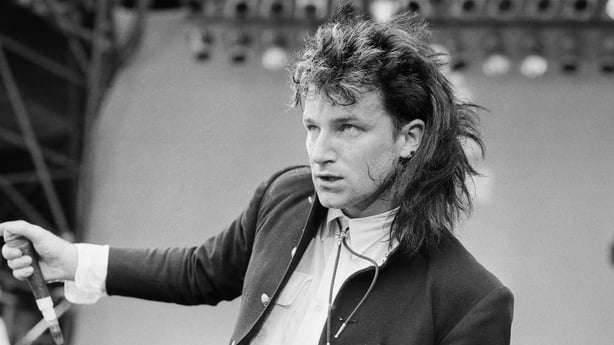
By the summer of 1985, U2 were already one of the most compelling bands in rock music—but they were not yet inevitable. Their albums sold well, their live shows were intense, and their reputation was growing rapidly. Still, they felt like a band in motion: restless, searching, and cautious about becoming too polished or predictable. They had momentum, but not yet destiny.
That would change in just 12 minutes at Live Aid.
When U2 arrived at Wembley Stadium to take part in the historic Live Aid concert, they were one act among many on a tightly scheduled global broadcast. Hundreds of millions of viewers around the world were watching. Each artist was given a narrow window—no room for indulgence, no margin for error. Hit the songs. Respect the clock. Exit cleanly.
For U2, and especially for Bono, this environment stripped performance down to its essence. There would be no elaborate staging, no extended set, no second chances. Just four musicians, a massive crowd, and television cameras broadcasting every move in real time.
Live Aid 1985: A High-Stakes Global Stage
Live Aid was designed for speed and efficiency. Backstage, the atmosphere was less romantic than historic: countdowns, cues, and constant reminders that overrunning your slot could disrupt the entire broadcast. The goal was scale, not subtlety.
But Bono has never been an artist driven purely by logistics.
As U2 took the stage at Wembley, the pressure was immense. The stadium was vast, the audience stretched far beyond the horizon, and the knowledge that the world was watching hovered over every second. This was not a venue for experimentation—or so it seemed.
“Sunday Bloody Sunday” Opens the Door
U2 opened their set with “Sunday Bloody Sunday,” its sharp, martial rhythm cutting through the afternoon air. The song was already well known, but hearing it echo across Wembley Stadium gave it new weight. The band played with discipline, conscious of the clock, focused on delivering impact without excess.
Then came the unexpected choice: “Bad.”
It was not a hit single. It was long, slow-burning, and unpredictable—hardly ideal for a short television slot. But “Bad” was the song Bono trusted when he wanted connection rather than applause. It was a risk, and it would redefine everything.
The Unscripted Moment That Changed Everything
Midway through “Bad,” something unplanned happened.
Bono noticed a young woman struggling near the front of the crowd, caught in the dangerous crush. Without hesitation, he stepped off the stage, climbed into the audience, and pulled her to safety. The band kept playing, stretching the song instinctively to match the moment.
From a broadcast perspective, it was chaos.
From a human perspective, it was unforgettable.
The cameras followed. The clock slipped. Producers panicked. And suddenly, Live Aid had a focal point that no rehearsal, cue card, or schedule could have predicted.
When Bono finally returned to the stage, precious minutes were gone. U2 were forced to cut their set short, dropping a planned song entirely. Technically, they had broken the rules.
Creatively, they had broken through.
From Band to Global Voice
In those few unscripted minutes, U2 stopped being just another act on a massive lineup. They became the emotional center of the day.
Viewers at home didn’t just see a performance—they saw vulnerability, urgency, and connection. Bono wasn’t posturing or grandstanding. He was present. The moment transcended music and became something deeply human.
The reaction was immediate. Critics took notice. Industry insiders did too. Conversations shifted almost instantly. U2 were no longer just a successful rock band—they were a live force capable of turning scale into intimacy.
Bono’s Philosophy Comes Into Focus
For Bono, the Live Aid moment crystallized a belief he had been circling for years: performance is not about perfection. It’s about presence.
That philosophy would go on to shape:
- U2’s future stadium tours
- Their ambitious visual storytelling
- Their willingness to address global and political issues onstage
But in 1985, that approach was still raw, risky, and unfiltered. There were no guarantees it would work.
Controversy and Consequences
Not everyone was pleased.
Some Live Aid organizers were frustrated by the overrun. Others questioned whether the moment was calculated. Bono himself has never framed it as strategy. What mattered was that it felt true—and audiences responded as though they had been waiting for exactly that kind of authenticity.
The moment wasn’t perfect. That was the point.
The Aftermath: A New Trajectory for U2
In the months following Live Aid, U2’s trajectory changed dramatically. Invitations grew larger. Expectations sharpened. The band’s visibility expanded beyond charts and radio into something more cultural and symbolic.
Soon, they would record The Joshua Tree, an album that carried the weight of having been seen—and heard—by the world. Live Aid didn’t create that album, but it created the space in which it could exist.
Why Those 12 Minutes Still Matter
It’s easy, decades later, to mythologize those 12 minutes at Live Aid. But their power lies in how fragile they were:
- A mistimed decision
- A crowd on the edge
- A broadcast that could have cut away
Instead, everything aligned just long enough to reveal what Bono and U2 were becoming.
Live Aid didn’t make them flawless.
It made them visible.
And once that door opened, there was no going back to being just another band on the bill.
Leave a Reply