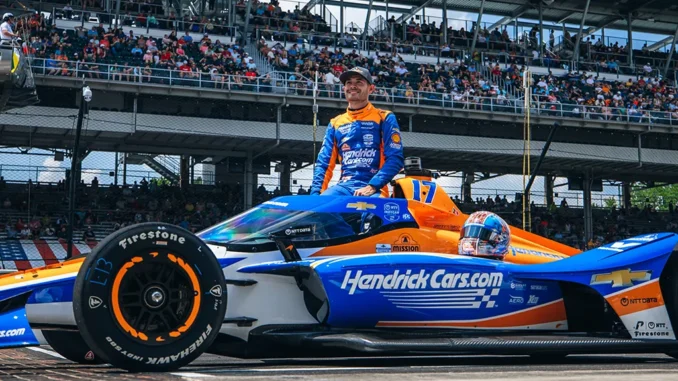
In the lead-up to one of the most anticipated races of the season, all eyes were on Kyle Larson as he geared up for a pivotal test session that was meant to serve as a cornerstone in his preparation. But just as momentum began to build, a crash on the track abruptly ended Larson’s run, slicing short the valuable time he had set aside to fine-tune his approach. While the early exit was far from ideal, Larson remained remarkably composed in the aftermath, choosing to focus on the benefits he gleaned before the incident.
It’s not unusual for Larson to draw headlines, whether for his dynamic racing style, raw talent, or his versatility across different motorsport disciplines. But this time, the story wasn’t about a spectacular win or a thrilling last-lap duel—it was about the unfortunate end to a key practice session and how Larson is mentally framing the experience in preparation for what lies ahead next month.
A Crucial Preparation Window
Larson, who is known for balancing commitments across multiple racing formats, including NASCAR and dirt racing, had pencilled in this test as one of his few opportunities to truly get a feel for the track ahead of the upcoming marquee race. With limited time and a self-professed disinterest in computer simulations—a common preparation method among his peers—Larson has historically leaned heavily on actual seat time to develop his rhythm and comfort on unfamiliar courses.
“I’m just not a sim guy,” Larson admitted earlier this week. “I never really have been. I learn best when I’m physically in the car, feeling the track, and understanding its flow. That’s what works for me, and that’s what I was hoping to maximize during this test.”
The session, held under clear skies and moderate track temperatures, started out promising. Larson was seen hitting consistent lines and working closely with his crew to make minor adjustments between stints. His times were competitive, and observers noted how quickly he seemed to be adapting to the track layout—an especially encouraging sign given that some of his competitors had already logged hours upon hours in simulators and test sessions.
The Incident
However, as the session wore on and drivers began pushing the envelope to simulate race conditions, things took a sudden turn. Coming out of a medium-speed corner, Larson appeared to lose rear grip and spun off into the barriers. Though the impact was not violent and Larson was unharmed, the damage to the car was significant enough to end his day prematurely.
“It just snapped on me,” Larson recounted in a post-session interview. “I was trying to find that limit, and I guess I stepped just over it. It’s disappointing, for sure. I wanted to finish out the session and gather more data. But that’s racing. It happens.”
Team engineers quickly began assessing the damage, and while initial reports suggested the crash wouldn’t significantly affect the overall race preparation calendar, the lost track time was undeniably a blow.
Silver Linings and Steady Perspective
Still, rather than dwell on the misstep, Larson chose to highlight what he had accomplished before the incident. According to him, the test had already yielded valuable insights.
“Honestly, I felt like we made a lot of progress before the crash,” Larson said. “We dialled in the balance, played with the aero settings, and I was getting into a groove. I learned a lot today, even if it didn’t end the way we wanted.”
He went on to outline several benefits gained from the test run:
- Track Familiarity: “I got a real sense of the track’s personality—where it flows naturally and where it’s tricky.”
- Team Synergy: “It gave me and the team a chance to communicate more in this specific setup. We made gains.”
- Adaptation Speed: “I proved to myself that I can get up to speed quickly, even without sim work.”
Larson also emphasized that while others may rely heavily on simulation software, his reliance on feel and instinct has always been a defining trait.
“I’m not saying sim work doesn’t help,” he clarified. “For a lot of guys, it’s essential. But I’ve built my career trusting what I feel in the seat. That’s my strength.”
The Broader Context
Larson’s test and subsequent crash come at a time when simulation technology has become almost ubiquitous in motorsport. From Formula 1 to IndyCar to NASCAR, drivers now spend countless hours in advanced simulators that replicate everything from weather conditions to tire degradation. In that sense, Larson represents something of a throwback—an old-school racer who prefers the analogue to the digital.
His approach is not without its risks. In a world where fractions of a second matter, any disadvantage in preparation can be costly. Yet, Larson has often defied those odds, leaning on sheer skill, adaptability, and mental acuity.
“Everyone has their process,” said former NASCAR champion Jeff Gordon. “What works for Kyle might not work for someone else. But he knows what he needs, and that’s what makes him dangerous on race day—even if things don’t go perfectly in testing.”
What’s Next?
With the crash now behind him, Larson and his team are pivoting to the next phase of preparation. That includes data analysis from the laps completed, simulator input from his engineers, and potentially, additional test sessions—schedule permitting.
Larson hasn’t ruled out making time for simulator work either, though he remains sceptical of its value compared to actual driving.
“If it comes down to it, I’ll look at the data, maybe sit in the sim for a bit. But nothing replaces real laps,” he said. “Hopefully, we can squeeze in another test before the race. If not, I still feel like we’re in a decent spot.”
Fan and Team Reaction
Fans took to social media to express a mix of concern and support. Many praised Larson’s positive attitude in the face of the setback, while others debated whether his avoidance of simulation work was hurting or helping his chances.
His team, meanwhile, expressed confidence that the test—even in its abbreviated form—would prove beneficial.
“We got what we needed,” said one engineer. “Sure, more laps would have been better, but we learned enough to move forward. Kyle’s feedback was sharp, and we’re adjusting accordingly.”
Final Thoughts
As the paddock buzz slowly settled following the crash, it was clear that Larson’s brief test session had become one of the more talked-about moments heading into next month’s big race. Not because it went smoothly, but because it captured the essence of Larson’s unique approach to the sport: all instinct, grit, and unshakable focus.
In a racing world increasingly dictated by technology and data, Kyle Larson continues to write his own playbook. And crash or no crash, that’s what keeps him in the conversation—not just as a contender, but as a one-of-a-kind competitor who thrives under pressure and learns from every lap, even the imperfect ones.
Leave a Reply