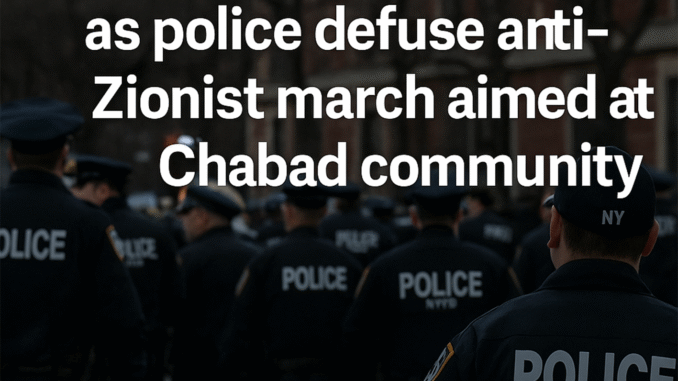
Protesters threaten to ‘flood’ Crown Heights as police defuse anti-Zionist march aimed at Chabad community.
A tense atmosphere gripped the Brooklyn neighborhood of Crown Heights on Saturday evening as New York City police intercepted a group of radical anti-Zionist demonstrators who had announced plans to “flood” the Chabad community and “rise up” in protest. The incident, which was quickly diffused before demonstrators reached the predominantly Jewish neighborhood, has reignited urgent conversations about community safety, protest rights, and antisemitic overtones masquerading as political expression.
The demonstration, organized by a loosely affiliated network of far-left activists under the banner of “Anti-Zionism for Justice,” was initially advertised as a protest against Israel’s ongoing military campaign in Gaza. But social media posts and leaked organizing messages revealed rhetoric far more incendiary than a standard protest—threats to “march directly into Crown Heights,” “surround the synagogues,” and even “rise up” against what organizers labeled “Zionist colonial structures” embedded within the Chabad community.
Those messages, publicized in real-time and flagged by concerned Jewish organizations, prompted a swift response from the NYPD and community security coalitions. Officers were stationed in multiple locations surrounding Crown Heights before the group could get near the neighborhood, ultimately rerouting the protest and avoiding what many feared could have turned into a dangerous confrontation.
Police Presence Averts Crisis
By mid-afternoon Saturday, officers from NYPD’s Strategic Response Group, Community Affairs Bureau, and local precincts formed a perimeter along Eastern Parkway and several key intersections. The department confirmed that they had received credible intelligence suggesting that the group—numbering roughly 200 by some estimates—was intent on redirecting their originally permitted march route to target Jewish community centers in Crown Heights.
Chief Jeffrey Maddox, a senior NYPD official who coordinated the response, told reporters,
“This was not about silencing protest. This was about preventing an inflammatory and potentially volatile situation from escalating in a dense residential area.”
Maddox added that several protesters ignored police instructions and attempted to push toward Kingston Avenue, a central hub of Chabad activity. Five individuals were detained for disorderly conduct and obstruction after failing to comply with dispersal orders. No injuries or significant property damage were reported.
Chabad Community on High Alert
Residents of Crown Heights, home to the world headquarters of the Chabad-Lubavitch movement, spent the afternoon in an uneasy state of vigilance. Community patrol groups, including Shomrim volunteers, were deployed throughout the neighborhood, and local synagogues cancelled evening programming out of caution.
Chabad spokesperson Rabbi Levi Stern said the threats had “crossed a red line” between political protest and ethnic intimidation.
“We are not a political movement. We are a religious and spiritual community,” Rabbi Stern stated.
“To target our homes, our synagogues, and our children under the guise of anti-Zionism is disgraceful and dangerous.”
Crown Heights has long served as a microcosm of broader American tensions. The neighborhood is a unique cultural and religious enclave that has historically coexisted with a diverse Black and Caribbean population. But the shadow of the 1991 Crown Heights riots still looms large, particularly in moments of racial or political unrest that intersect with Jewish life.
Many community members drew painful parallels between Saturday’s attempted incursion and past incidents of antisemitic violence in New York, including the Monsey Hanukkah attack in 2019 and the Jersey City kosher market shooting the same year.
Blurring the Line Between Protest and Intimidation
What’s deeply concerning to many observers is the increasingly common tactic of targeting Jewish institutions and neighborhoods in protests ostensibly aimed at Israel or Zionism.
Experts on extremism and hate speech caution that the line between anti-Zionism and antisemitism often becomes dangerously thin in emotionally charged demonstrations—especially when geography, not policy, becomes the protest’s focal point.
Dr. Rachel Klein, a professor of political science at CUNY who studies protest movements, commented on the Crown Heights event:
“You cannot claim to be protesting a foreign government and then physically target a community of American Jews who may or may not even identify politically with that government. That becomes a form of collective scapegoating.”
This concern was echoed by Mayor Eric Adams, who issued a statement Saturday evening condemning the threats against Crown Heights and reaffirming the city’s commitment to safeguarding religious freedom and community safety.
“We will never tolerate the targeting of New Yorkers based on their faith, ethnicity, or cultural identity—period,” Adams said.
“Peaceful protest is a cornerstone of our democracy, but threatening neighborhoods and intimidating residents crosses the line.”
A National Pattern Emerging?
Saturday’s incident is not isolated. Jewish communities across the U.S. have reported similar encounters in recent months as Israel’s military actions in Gaza continue to provoke global outrage. Protests outside synagogues in Los Angeles, anti-Zionist graffiti in Boston, and disruptions of Jewish student events at college campuses are all part of a growing trend that is beginning to alarm federal agencies.
The Anti-Defamation League (ADL) issued a nationwide alert last week warning Jewish institutions to be “particularly vigilant” around pro-Palestinian demonstrations, citing “a sharp uptick in coordinated harassment and location-targeted activism.”
ADL CEO Jonathan Greenblatt responded directly to the Crown Heights situation:
“Let’s be clear—marching into a religious neighborhood while shouting about Zionism is not activism; it’s intimidation. It’s antisemitism.”
Organizers Double Down
Despite the backlash, protest organizers showed no signs of backing down. In a statement posted on social media late Saturday night, the coalition behind the march accused police of “protecting settler ideology” and vowed to return “in greater numbers.”
The post read in part:
“We will not be silenced by cops or Chabad loyalists. The people of Gaza deserve more than prayers—they deserve our resistance in the streets.”
The language, many noted, again ignored the distinction between a foreign policy grievance and the domestic implications of mob-style protests targeting ethnic communities.
Looking Ahead
Security remains high in Crown Heights, and additional patrols have been scheduled through the end of the week. Community leaders are calling for dialogue, but also demanding that city officials draw clear lines on protest boundaries and neighborhood targeting.
For now, the question remains: How far can political protests go before they become threats?
As the U.S. grapples with rising tensions at the intersection of international conflict and domestic identity, the events in Crown Heights may serve as a sobering warning—and a necessary opportunity—for New York and the nation to reevaluate how we define activism, how we draw the line at hate, and how we keep our communities safe.
Leave a Reply