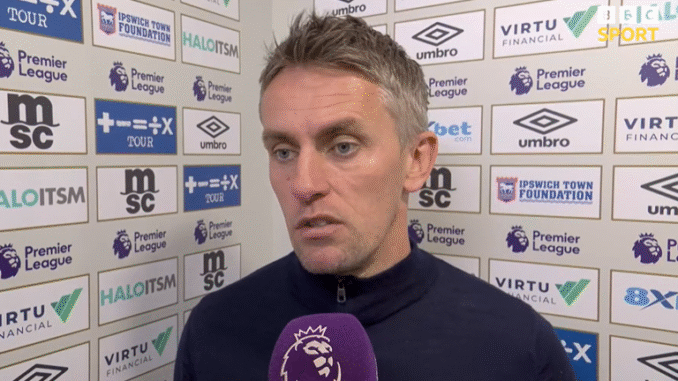
After a fairytale climb to the Premier League, Ipswich Town now finds itself peering over the edge of uncertainty. From the outside, it looked like a miracle — a club that spent years lost in the shadow of its history, now suddenly reborn and scrapping with England’s elite. But as the end of the 2024–25 Premier League season nears, the Tractor Boys face an unsettling truth: survival was never going to be easy, and the margin for error has shrunk to almost nothing.
On Saturday, they head to Goodison Park to face Everton in a fixture that, on paper, means little in the grand scheme of the league. Everton, long safe from relegation and far from the European conversation, has little to play for. But for Ipswich, even if safety is mathematically out of reach or has been secured, depending on the results around them, the symbolic weight of the match is immense. It’s about pride, lessons, and a blueprint for what comes next.
A Meteoric Rise—But At What Cost?
Only two seasons ago, Ipswich Town were a League One side. Under manager Kieran McKenna, they executed one of the most ambitious and energetic rebuilds in recent Football League memory. Backed by the American-led Gamechanger 20 Ltd. consortium and a fanbase starved of top-flight football, Ipswich secured back-to-back promotions — first from League One in 2023, then automatically from the Championship the following season.
What made their rise so compelling was the style: fearless attacking football, heavy emphasis on data-driven recruitment, and a manager with tactical clarity and poise beyond his years. McKenna was hailed as the “next big thing,” a former Manchester United assistant who brought calm and precision to a historically volatile club.
However, the Premier League, as many promoted clubs learn the hard way, is an entirely different beast. While Ipswich impressed early on — taking points off Brighton, Wolves, and even holding Arsenal to a draw in October — the winter months exposed the squad’s fragility. The congested fixture list, injuries to key players like Leif Davis and Conor Chaplin, and a punishing run of games against top-six opponents quickly dragged them into the relegation conversation.
What Went Wrong?
1. Lack of Premier League Experience
Ipswich entered the season with one of the youngest and least experienced squads in the top flight. While their youth brought energy and enthusiasm, it also translated to lapses in concentration and naiveté in game management. In matches where Premier League know-how matters — think away at Crystal Palace, home to Fulham, or even against Burnley — Ipswich dropped crucial points from winning positions.
2. Injuries and Squad Depth
For a club promoted so rapidly, depth was always going to be an issue. Kieran McKenna opted to keep faith with many of the players who earned promotion, a noble move but one that perhaps cost the team in terms of competitiveness. When key figures like Wes Burns, Sam Morsy, or George Hirst were sidelined, the drop-off in quality became too obvious.
January reinforcements were modest — a loan deal for Southampton’s Sekou Mara and a short-term contract for an out-of-favour Premier League centre-back — but they lacked the transformative impact seen in the likes of Luton or Nottingham Forest last season.
3. Home Form Collapse
Portman Road was supposed to be Ipswich’s fortress. Yet, as the season wore on, teams began to figure out how to quiet the crowd and suffocate Ipswich’s high-press game. A run of four consecutive home defeats in February and March — including a 1–4 drubbing by Bournemouth — effectively sealed their fate. The fear factor vanished, and along with it, any momentum.
4. Tactical Stagnation
McKenna’s principles — possession-heavy, high pressing, wide overloads — won plaudits in the lower leagues. But the Premier League’s analytical edge meant teams quickly adapted. There were games where Ipswich looked out of ideas when their Plan A didn’t work. The reluctance to switch to a more pragmatic approach in crucial fixtures was admirable in its purism but may have ultimately been misguided.
Everton vs. Ipswich—A Glimpse at the Future?
So what should we expect on Saturday? Everton, now comfortably mid-table, will likely rotate their squad. Manager Sean Dyche may give younger players a chance or opt to rest stalwarts like James Tarkowski or Dwight McNeil.
For Ipswich, however, the stakes are different. Even if relegation is already confirmed by kickoff, this is no dead rubber. Every minute played at this level matters for the players’ development and for McKenna’s ongoing evaluation of who’s ready for the Championship — or potentially another crack at Premier League football.
Predicted Lineups
Everton XI (4-4-1-1):
Pickford; Patterson, Branthwaite, Tarkowski, Mykolenko; Danjuma, Onana, Garner, Dobbin; McNeil; Calvert-Lewin
Ipswich XI (4-2-3-1):
Hladky; Clarke, Woolfenden, Burgess, Davis; Morsy, Luongo; Burns, Broadhead, Chaplin; Hirst
What’s Next?
If Ipswich goes down—and at the time of writing, they are teetering on the brink — the challenge will be one of retention and recalibration. The board has made it clear they back McKenna, and the manager himself has expressed loyalty to the project. But interest in key players will be high.
- Leif Davis has attracted attention from Brentford and West Ham.
- With 10 goals and 5 assists, Conor Chaplin is being watched by mid-table Bundesliga clubs.
- Kieran McKenna, despite the struggles, remains a hot managerial prospect.
The club’s wage bill and recruitment model are sustainable, which bodes well for a bounce-back attempt. Yet fans will remember how hard the Championship is, especially for clubs trying to keep hold of Premier League-calibre talent.
Cause for Optimism?
Absolutely. Ipswich’s fall was not a collapse, but rather a correction — a reckoning with the brutal arithmetic of top-flight football. They didn’t spend recklessly, they didn’t panic, and most importantly, they stayed true to their identity.
If McKenna stays and if the core of the squad remains intact, Ipswich Town could be one of the strongest sides in the Championship next season. With parachute payments and a shrewd recruitment policy, there is every chance that this year will be remembered as a necessary learning curve.
And should they survive against the odds, even better — the blueprint is already laid, the pain already felt. The Premier League has humbled giants and elevated minnows. Ipswich may be bruised, but they are far from broken.
As the sun sets on their rollercoaster season, the Tractor Boys must decide: was this the end of a dream or merely the start of a new, wiser one?
Leave a Reply