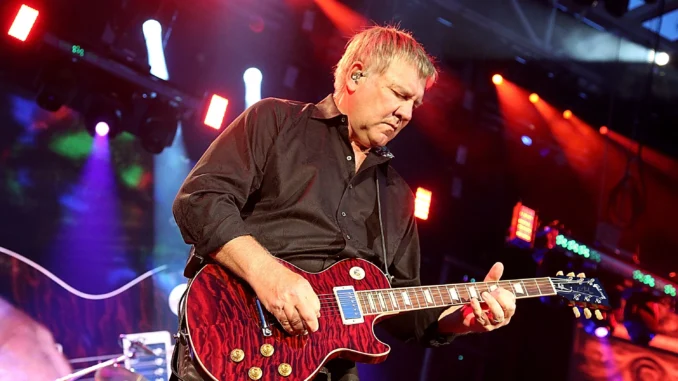
When you’re part of one of the most celebrated rock bands in music history, choosing a favorite moment from a decades-long career can be a difficult task. But for Alex Lifeson, the legendary guitarist of Canadian prog-rock titans Rush, one album stands out as not just a creative triumph, but a downright joyful experience. In a recent interview, Lifeson candidly shared which album he had the “most fun” making—and fans may be surprised to learn it was one of Rush’s biggest records.
The Band That Did Things Their Way
Rush was never a band that followed trends. From their early hard rock beginnings to their intricate and conceptual prog rock masterpieces, and into the synth-heavy explorations of the ‘80s, Rush consistently followed their own creative compass. With a lineup as stable as a granite boulder—Alex Lifeson on guitar, Geddy Lee on bass, vocals and keys, and the late, legendary Neil Peart on drums and lyrics—Rush built a fiercely loyal fanbase while crafting some of the most challenging and rewarding music in rock.
So when Lifeson opens up about his personal highlights, fans listen. After all, the guitarist’s rich, textural playing was a key ingredient in the band’s unique sound. Recently, Lifeson revealed that the album he had the most fun making was none other than Moving Pictures—a record that not only elevated Rush to new heights commercially but also captured the band at a moment of peak creativity and cohesion.
The Making of Moving Pictures: A Joyous Challenge
Released in 1981, Moving Pictures was Rush’s eighth studio album and became an instant classic. Anchored by now-iconic tracks like “Tom Sawyer,” “Limelight,” and “Red Barchetta,” the album fused complex musicianship with accessible songwriting in a way that few prog bands had managed before—or since.
In interviews, Lifeson has spoken fondly about the experience of creating Moving Pictures. “It was just a period where everything was flowing,” he explained. “We were locked in creatively, and personally, it was one of the best times we had as a band. There was laughter, experimentation, and no sense of being under a microscope.”
This is a notable contrast to many stories of bands creating career-defining albums. Often, the pressure to deliver can cause tension, ego clashes, or creative burnout. For Rush, it was quite the opposite. Moving Pictures was the sound of a band hitting its stride and enjoying the process.
The Perfect Storm of Chemistry and Confidence
What made Moving Pictures such a fun record to make, according to Lifeson, was the sense of confidence the band had built up by that point. After experimenting heavily on albums like 2112, Hemispheres, and Permanent Waves, Rush refined their ability to balance technical proficiency with emotional resonance. “We’d found a groove, creatively speaking,” Lifeson said. “Everyone was firing on all cylinders.”
The recording took place at Le Studio in Morin-Heights, Quebec—a location affectionately dubbed “Rush’s Abbey Road.” The band loved the relaxed yet professional atmosphere of the rural studio, which allowed them to fully immerse themselves in the music without outside distractions. The snowy mountain setting was scenic and peaceful, adding to the sense of focus and camaraderie that permeated the sessions.
The studio environment and the band’s interpersonal chemistry created the conditions for a creatively liberating experience. Lifeson recalls spending long hours tinkering with guitar tones, trying out new effects, and exploring spontaneous ideas without fear of judgment or time pressure. “It was like being kids in a candy store,” he laughed.
A Legacy Album with a Personal Touch
While Moving Pictures is often dissected for its compositional complexity and lyrical depth, the album is also a testament to the joy of musical discovery. Lifeson’s guitar work on tracks like “YYZ” and “The Camera Eye” showcases his versatility—from aggressive riffing to atmospheric textures—and it’s clear that he relished every moment of the recording process.
Perhaps that’s part of why the album still resonates so deeply with fans more than four decades later. It wasn’t just technically brilliant—it was made with passion, freedom, and genuine enjoyment. As Lifeson put it, “You can hear it in the recordings. There’s energy there that only comes when you’re having a good time.”
Even Neil Peart, known for his perfectionism and intense work ethic, seemed to find the process invigorating. His drum parts on Moving Pictures are some of the most celebrated in rock history, and they were crafted with the same sense of playful exploration that Lifeson recalls. Geddy Lee, too, brought an inspired touch to the album, with his distinctive bass lines and evolving synth work helping to define Rush’s sound for the decade to come.
Commercial Success Without Compromise
One of the more remarkable aspects of Moving Pictures is how it managed to be both critically and commercially successful without sacrificing the band’s artistic integrity. The album went quadruple platinum and introduced Rush to a broader audience, thanks in part to the success of “Tom Sawyer,” which became their signature song.
Despite this mainstream breakthrough, the band never watered down their approach. The songs are intricate, dynamic, and often challenging, yet they still connect on an emotional level. Lifeson believes that balance was key: “We weren’t trying to write hits. We were just making music we loved. That honesty, I think, is what people responded to.”
A Moment in Time Never Repeated
While Rush would go on to make many more albums—each with its own highlights—Moving Pictures remains a singular moment in their history. It was a point where inspiration, collaboration, and circumstance all lined up perfectly. For Lifeson, the memory of those sessions still brings a smile.
“In the studio, there was this feeling that we were doing something special, even if we didn’t fully realize it at the time,” he said. “We were just having fun, and sometimes, that’s when the best stuff happens.”
Fans couldn’t agree more. To this day, Moving Pictures continues to inspire musicians and listeners alike. Its songs are staples on classic rock radio, and its influence can be heard in countless bands across genres. But perhaps its most enduring quality is the spirit in which it was made—a spirit of joy, curiosity, and creative freedom.
A Tribute to Lifeson’s Legacy
Alex Lifeson’s recent reflections on Moving Pictures serve as a reminder of what made Rush such a unique and enduring band. They weren’t just virtuosos—they were friends who loved making music together. That joy, according to Lifeson, is what he’ll always cherish most.
“There’s something magical about that album,” he said. “Every time I hear it, I’m transported back to that studio, to that time. It really was the most fun I ever had making a record.”
And in the end, that joy is palpable in every note. That’s the Rush way. And that’s the Lifeson legacy.
Would you like a photo collage or timeline graphic to go along with this blog post?
Leave a Reply