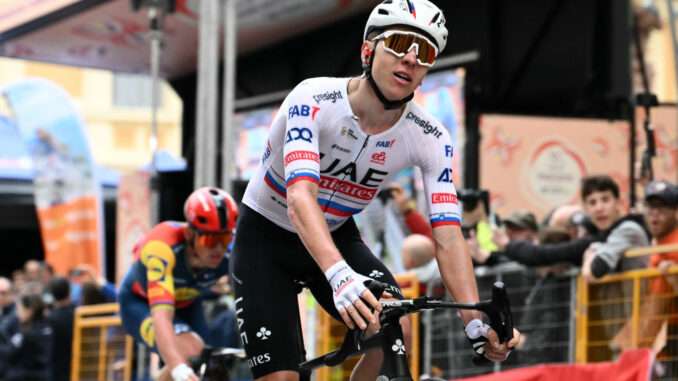
In the lead-up to the grueling Titan Desert race in Morocco, two former WorldTour riders, Luis Ángel Maté and Andrey Amador, opened up to Spanish media outlet EFE in a revealing and blunt conversation. Their criticism wasn’t directed at the desert’s punishing terrain or their own preparations—it was leveled squarely at what they described as the growing “monotony” in professional cycling, fueled by the overwhelming dominance of Slovenian phenom Tadej Pogačar.
The sentiment from the former Cofidis and Euskaltel rider Maté was clear: “I’m sick of always having the same guy win.” Echoed by Amador—veteran of Movistar, INEOS, and EF Pro—the remarks have sparked a heated debate in the cycling community, raising questions about the current state of the sport, the nature of competition, and whether professional cycling has grown too clinical, too specialized, and perhaps, too predictable.
The Rise of a Superchampion
Tadej Pogačar is, by all statistical and visual accounts, a once-in-a-generation athlete. At just 25, the UAE Team Emirates leader has already collected two Tour de France titles, multiple Monuments—including Il Lombardia and Liège–Bastogne–Liège—and the coveted rainbow jersey as UCI Road World Champion.
Most recently, Pogačar added yet another chapter to his legend at Liège–Bastogne–Liège 2024, crushing the competition with a solo attack on the Côte de la Redoute. By the time he crossed the finish line, his gap was unbridgeable. For fans, it was a masterclass. For rivals, it was despair. And for some former pros, it’s getting, well… boring.
Maté: “You Know the Winner Before the Race Starts”
Luis Ángel Maté didn’t mince words in Morocco. “Pogačar is phenomenal, sure. But we’re losing unpredictability,” he said. “Back when I raced, even in the big races, you had at least five or six guys you truly believed could win. Now, you look at the start list, and everyone already knows who’s going to ride away on the final climb.”
Maté, known for his gritty style and tireless breakaway efforts in Grand Tours, believes part of the issue is the increasing gap between top-tier riders and the rest. “Training, data analysis, nutrition, recovery—it’s all optimized to the decimal. Great for performance, yes, but where’s the human element? Where’s the surprise?”
He isn’t wrong. Pogačar’s Strava uploads from Liège revealed power outputs that seem almost superhuman: averaging over 400 watts for extended efforts, with decisive attacks producing sustained bursts above 1,000 watts. Maté argues that such numbers, combined with superior team tactics and nearly unlimited support, have created a “cycling elite” that feels untouchable.
Amador: “It’s Not Just Pogacar. The Whole System Has Changed.”
Andrey Amador, Costa Rica’s most successful road cyclist, agreed but pointed to a broader issue. “It’s not just Pogačar. It’s the system. Riders today are robots. Every calorie, every heartbeat, every watt—they’re all tracked and optimized. That’s why younger guys are dominating. The old learning curve is gone.”
Amador, who rode alongside the likes of Alejandro Valverde and Richard Carapaz, believes the romance of the sport is at risk. “We used to race with intuition. You attacked because you felt strong or because you saw a weakness. Now, riders wait until the final 2.3 kilometers because that’s where the data says they have the best chance. It’s like watching chess on bikes.”
His criticism goes beyond mere nostalgia. Amador warns that this ultra-professionalism could be hurting the sport’s accessibility. “Kids don’t dream of becoming Pogačar anymore because they know they’ll never have the money, the lab-tested training, or the genetics to get there.”
Are We in a “Pogačar Era”? And Is That Bad?
Dominance in sport is nothing new. Michael Jordan in basketball, Serena Williams in tennis, Lionel Messi in football—every era has its figurehead. But what makes Pogačar’s reign feel different, according to critics, is how early and thoroughly he’s begun to own the narrative. There’s also the lack of consistent challengers.
Jonas Vingegaard remains his fiercest rival, having dethroned Pogačar at the 2022 and 2023 Tour de France editions. But Vingegaard’s recent injuries and team dynamics at Visma–Lease a Bike may leave him out of this year’s battle. Remco Evenepoel, another generational talent, has struggled with consistency and tactics in Monument races, and Primož Roglič, though strong, appears past his peak.
This vacuum creates a reality where Pogačar isn’t just the favorite—he’s often the only logical pick.
Fans Divided: Awe vs. Apathy
Social media reactions to Maté and Amador’s statements have been mixed. Some fans agree that a lack of unpredictability can dull the excitement of watching cycling’s biggest races. Others argue that Pogačar’s genius should be celebrated, not criticized.
“He’s not boring,” wrote one Twitter user. “He’s legendary. You don’t boo Mozart for composing too well.”
But others see value in the ex-pros’ perspective. “We need more underdog stories, not just Pogačar and UAE domination,” another fan posted.
A Possible Shift?
Interestingly, Pogačar himself has hinted that he may shift his focus away from the Tour de France in the coming years, perhaps targeting the Giro-Tour double or expanding his dominance to stage races and time trials. Could that open the door for a new face to emerge?
Perhaps. But insiders warn that unless the UCI and teams look seriously at leveling the playing field—perhaps by capping budgets, limiting technological aid, or even tweaking race formats—the trend will continue.
“You can’t legislate against talent,” Amador admits. “But you can make sure it doesn’t become a monopoly.”
A Future of “Managed Excitement”?
Ultimately, the tension between performance optimization and sporting drama is not unique to cycling. Formula 1, too, wrestles with questions about domination and audience interest. As sports become more scientific, spontaneous brilliance becomes rarer—and arguably, more precious.
In cycling’s case, the emergence of Tadej Pogačar is both a blessing and a challenge. His supremacy forces the sport to confront uncomfortable questions: What makes a race exciting? Can too much excellence become… dull?
If Maté and Amador have anything to say about it, now is the time to find answers—before fans tune out from races where the outcome feels scripted.
For now, Pogačar marches on. The peloton will continue to chase. And cycling, as always, must navigate the tension between progress and unpredictability—between excellence and entertainment.
Leave a Reply