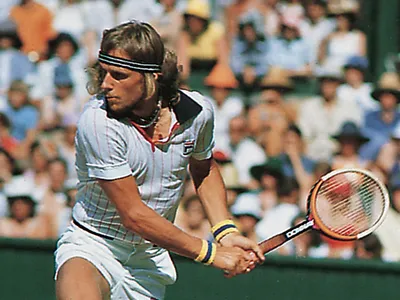
In the dynamic and evolving world of professional tennis, few names resonate with the same reverence and awe as Björn Borg. A five-time Wimbledon champion and six-time French Open victor, Borg revolutionized the sport in the 1970s and early 1980s with his stoic demeanor, unrivaled stamina, and icy-cold focus. But despite being an undisputed legend of the game, Borg recently made headlines again, not for a comeback, but for a candid comparison between his era and today’s tennis titans.
In an honest and thoughtful commentary, Borg described today’s game as more “gruelling” than during his peak years, reflecting on the physical, mental, and promotional responsibilities today’s athletes bear. The tennis icon, who reigned as world No. 1 for 109 weeks and won 11 Grand Slam titles, offered a nuanced perspective that bridges the past and present of the sport he helped elevate to global popularity.
From Ice Man to Analyst: Borg’s Post-Retirement Perspective
Since his retirement at just 26 years old, Borg has remained an enduring figure in tennis lore. While many of his contemporaries faded into obscurity, Borg’s legacy has only grown stronger. Whether through appearances at Grand Slam ceremonies, his role as captain of Team Europe in the Laver Cup, or his sage insights on today’s generation of players, Borg has remained deeply connected to the sport.
In a recent interview during a promotional event tied to the ATP Tour, Borg addressed the current state of tennis, drawing on his experiences and contrasting them with the modern game.
“It’s a very different time now. The sport is faster, more physical, and definitely more grueling,” Borg remarked. “When I was playing, we trained hard, but the demands now, both physically and mentally, are on another level.”
Comparing Eras: The Timeless Debate
Borg’s comments have reignited the age-old debate in tennis circles: Which era was tougher, then or now? For his part, Borg isn’t downplaying the grittiness of his era. The 70s and early 80s were marked by a brutal schedule, wooden rackets, slower courts, and less advanced recovery systems. However, he acknowledges that modern tennis imposes its own set of Herculean demands.
Where Borg’s era emphasized endurance, finesse, and psychological warfare over long, multi-week tournaments, today’s game rewards explosive athleticism, aggressive baseline play, and almost robotic consistency. Players like Novak Djokovic, Rafael Nadal, Carlos Alcaraz, and Jannik Sinner are expected to maintain peak form across a calendar that spans nearly 11 months, with minimal off-season downtime.
“The intensity today is non-stop,” Borg observed. “These guys don’t get much rest. Between travel, competition, and media, it’s a full-time job 365 days a year.”
The Gruelling Modern Game: Speed, Science, and Scrutiny
Modern tennis is as much about science and athletic conditioning as it is about skill. Players undergo rigorous fitness regimens tailored by nutritionists, physiotherapists, and psychologists. Each match can be a four-hour physical marathon involving relentless rallies, high-speed movement, and advanced tactical play.
Borg reflected on the advancement of technology in tennis:
“With today’s rackets and strings, players generate more spin and power. It’s incredible to watch. But it also makes the rallies longer, and the strain on the body is huge.”
He’s not wrong. A modern best-of-five Grand Slam match often features baseline exchanges that would have been unheard of during his prime. The average rally length has increased, as has the total match duration. Factor in frequent travel across continents, late-night matches, and media scrutiny, and it’s easy to see why today’s pros operate in a pressure cooker environment.
The Role of Modern Stars: More Than Just Tennis
Borg also highlighted a new dimension of responsibility placed on modern athletes: global promotion of the sport. While tennis legends like him played in an era when media obligations were far less demanding, today’s stars are global brand ambassadors, often balancing sponsorship deals, press conferences, social media engagements, and charitable commitments alongside their intense competition schedules.
“These players carry a big responsibility—not just to win matches, but to promote the sport globally. It’s part of being a top player now,” Borg emphasized.
Indeed, players like Roger Federer, Serena Williams, and Naomi Osaka have redefined what it means to be a tennis star in the modern era. Their off-court personas and brand presence have helped grow the game into new markets, inspiring millions of young fans. However, this visibility also comes with heightened scrutiny, often affecting mental health, a factor Borg noted was not as openly discussed during his playing days.
Mental and Emotional Toll: Then vs. Now
While Borg was renowned for his emotionless demeanor—earning him the nickname “Ice Man”—he acknowledges that the mental challenges of today’s players are more public, more nuanced, and, in some ways, more demanding.
“We didn’t talk much about mental health or emotional fatigue. You just played. But today, we’re seeing players be more open, and I think that’s very important for the sport.”
Modern players face relentless performance expectations, fueled by 24/7 media coverage and the constant buzz of social media. The pressure to perform perfectly, week in and week out, can wear down even the most seasoned athletes.
A Living Legend’s Lasting Legacy
While Borg reflects on the current state of tennis with admiration and a touch of sympathy, his own contributions to the sport remain unmatched in several respects. At just 25 years old, he had already amassed 11 Grand Slam titles, including a historic five straight Wimbledon titles from 1976 to 1980. His rivalry with John McEnroe, especially the epic 1980 Wimbledon final, is still considered one of the greatest matches in tennis history.
Borg’s playing style—meticulous, counterpunching, and built on consistency—helped usher in the era of baseline dominance that modern players have evolved. He was also one of the first to show how mental toughness could be as potent a weapon as a booming serve or a crushing forehand.
What Björn Borg Wishes for the Future
Borg closed his remarks by emphasizing the importance of balance in today’s game. He hopes that young players, while aiming for greatness, also learn to take care of their mental and emotional health.
“I want to see players enjoy the game. It’s a hard life, yes, but it’s also a beautiful journey. They have a chance to inspire the world—just like we did, but in their own way.”
He remains optimistic about the sport’s direction and feels reassured that the torch is in capable hands. With stars like Carlos Alcaraz, Iga Świątek, and Coco Gauff embracing their roles as both athletes and ambassadors, the next era of tennis seems poised to thrive.
A Bridge Between Generations
Björn Borg’s reflections are more than a nostalgic glance backwards—they are a powerful endorsement of the modern game and a timely reminder of the endurance and evolution that tennis demands. His verdict that today’s tennis is “more gruelling” doesn’t diminish his era—it elevates the current one, recognizing that every generation builds upon the last.
As fans, we’re fortunate to live in an era where past legends like Borg still offer their wisdom while watching new icons forge history on center court. It’s this rich tapestry of tradition and transformation that keeps tennis not only alive but thriving.
Leave a Reply