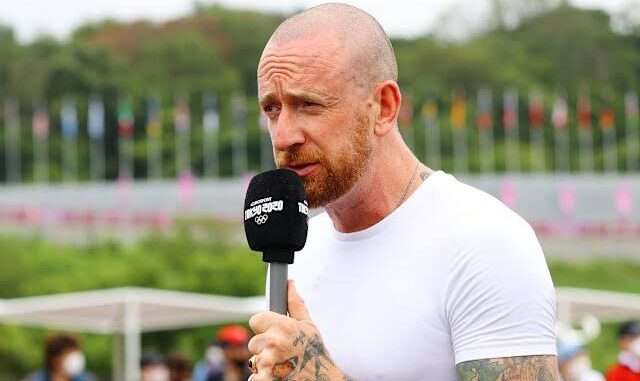
When Sir Bradley Wiggins—the first Briton to win the Tour de France and a five-time Olympic gold medalist—reflects on the defining figures that shaped his journey from a London council estate to global sporting stardom, one name looms surprisingly large: Lance Armstrong.
Yes, that Lance Armstrong—the controversial American cyclist whose name became synonymous with both sporting triumph and the most notorious doping scandal in the history of professional athletics.
In a recent interview that’s already generating heated discussion across social media and cycling circles, Wiggins opened up about the profound influence Armstrong had on his career. Far from shying away from the shadow that Armstrong’s legacy casts over professional cycling, Wiggins confronted it head-on, describing Armstrong as both “an inspiration” and a figure to whom he feels a deep sense of indebtedness.
“He Made Me Believe I Could Be Great”
Speaking during a special BBC podcast commemorating the 10th anniversary of his 2012 Tour de France victory, Wiggins was asked about the athletes who most shaped his mental and physical approach to elite competition.
“Lance was everything to me growing up,” Wiggins said without hesitation. “Before I ever wore the yellow jersey, I saw him in it, riding up the Alpe d’Huez like he owned the mountains. He made me believe that a cyclist could be a superstar, that a kid from Kilburn could dream that big.”
Wiggins acknowledged the obvious controversy surrounding Armstrong but emphasized that, for him, the emotional and aspirational impact of Armstrong’s Tour de France dominance in the early 2000s went beyond the later revelations of doping.
“Of course, what came out about him was heartbreaking,” Wiggins admitted. “But when I was a young lad getting on a bike for the first time, watching Armstrong win, beat cancer, and dominate the sport—it gave me a sense of purpose. I can’t deny what that meant to me.”
A Complex Relationship with Legacy
It’s a statement that cuts to the heart of a difficult truth in modern sport: inspiration often exists in shades of gray. Lance Armstrong was stripped of his seven Tour de France titles in 2012 and banned from competitive cycling for life after the U.S. Anti-Doping Agency concluded he led “the most sophisticated, professionalized and successful doping program that sport has ever seen.”
But for Wiggins—and many other athletes of his generation—Armstrong’s story, at least at the time, was one of overcoming adversity, of mental toughness, and of defying odds. For a boy like Wiggins, who grew up with an absent father and struggled through a chaotic adolescence, Armstrong’s narrative was more than just sport—it was survival.
“I was trying to escape things in my own life,” Wiggins explained. “Lance represented control, discipline, focus—things I didn’t have growing up. He showed me how to commit fully to something.”
Wiggins’ own father, Gary Wiggins, was a professional cyclist from Australia but abandoned the family when Bradley was just a toddler. The absence of a paternal figure in his formative years created a vacuum—a void that Armstrong, in a very unexpected way, helped fill.
“I didn’t have that father figure. Lance, from afar, became that for me,” he said.
Cycling Fans React: Admiration or Amnesia?
Wiggins’ comments have sparked passionate debate online, with some fans praising his honesty and others questioning the ethics of drawing inspiration from a man many see as having defrauded the sport.
On X (formerly Twitter), the hashtags #WigginsOnArmstrong and #CyclingLegacies began trending shortly after the podcast aired.
“Wiggins just gave the most human, nuanced take on Armstrong I’ve heard,” wrote one user. “Not everything is black and white.”
But others were less charitable: “Sir Brad owes his sport to honesty. Armstrong was a fraud. Why celebrate him in any way?” another user wrote.
British sports journalist Laura Whitmore weighed in, writing in a column: “It’s possible to be grateful for what someone represented to you at a time without endorsing everything they did. That’s the nuance Wiggins is trying to express—and it’s something sport desperately needs more of.”
The Torch That Still Burns
Despite his admiration, Wiggins made it clear that he never condoned the cheating that ultimately defined Armstrong’s career.
“I can separate the man who rode a bike from the choices he made,” Wiggins said. “He crossed a line I never did. But he lit the torch I carried, whether I like it or not.”
Wiggins, who rode clean throughout his career and was part of a generation that marked a cultural shift in the sport post-Armstrong, is proud of his own legacy. But he remains candid about the human complexity behind inspiration.
“I became who I was because of the image he projected. Not the reality, maybe. But the idea. And that idea gave me wings.”
Armstrong himself has responded to Wiggins’ words with what appeared to be a heartfelt acknowledgment on his Instagram story, posting a photo of Wiggins winning the 2012 Tour alongside a simple caption: “Grateful for your words, Brad. Respect.”
The Cost of Heroes, and the Price of Truth
In a time where public figures are routinely deconstructed and reevaluated in light of past actions, Wiggins’ take stands out not for its revisionism, but for its willingness to embrace contradiction.
As he continues to mentor young British riders and work as a broadcaster for the BBC, Wiggins is clearly still grappling with the influence Armstrong had on his psyche. But his honesty may serve as a blueprint for how athletes can talk about the flawed figures who nevertheless helped shape them.
“I’ll never defend what he did to the sport,” Wiggins said, pausing reflectively. “But I also won’t pretend he didn’t matter. Lance Armstrong was my North Star, even if he was pointing in the wrong direction. From him, I learned both how to chase greatness—and how not to lose your soul along the way.”
Between Glory and Fallibility
In the end, Wiggins’ tribute to Armstrong is not one of unqualified praise, but of reflection. It’s a recognition that human beings are rarely either saints or villains. Often, they are both—and more.
For young athletes today, the story offers a layered perspective: inspiration doesn’t require perfection. And legacy, in all its complexity, is a conversation that evolves with time.
As Wiggins put it: “We don’t choose our heroes based on their perfection. We choose them based on what we need at the time. And sometimes, that’s enough to get us to where we’re going.”
Share your thoughts: Who inspired you, and did that change over time? ️ #WigginsOnArmstrong #CyclingLegends
Leave a Reply