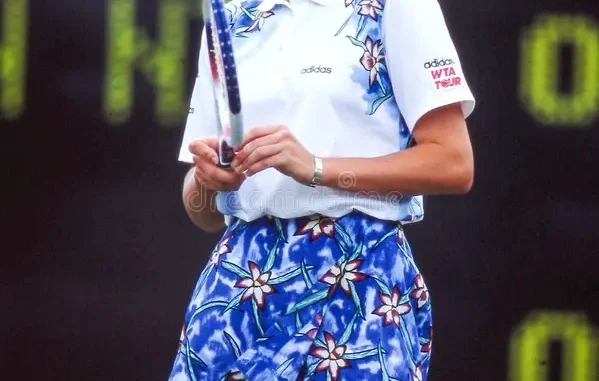
In the grand history of professional tennis, very few names resonate with the same magnitude as Stefanie Maria Graf. Born on June 14, 1969, in Mannheim, West Germany, Graf transcended the expectations of her time to become not just a sports legend but a cultural icon whose legacy continues to inspire athletes across generations.
With a career that defies conventional metrics of greatness, Graf’s accomplishments are staggering: she held the world No. 1 ranking in women’s singles for a record-shattering 377 weeks, more than any player in tennis history—man or woman. She ended eight seasons as the year-end No. 1, another unmatched feat, highlighting her unparalleled consistency and dominance.
Yet, beyond the statistics, it’s the path she carved, the titans she toppled, and the transformation she sparked in women’s tennis that solidify her legendary status.
The Prodigy Who Stunned the World
Graf’s rise to prominence began as early as age 13, when she became the youngest player in history to compete in a Grand Slam main draw at the 1983 French Open. It was a remarkable feat that foreshadowed a career marked by record-breaking milestones. Even at that young age, her game was a paradox of raw power and elegant precision—a foreshadowing of what was to come.
Guided by her father and coach, Peter Graf, young Steffi trained rigorously, often with intensity rare for someone of her age. The meticulous focus on fitness, footwork, and a ruthless forehand laid the groundwork for a new archetype in women’s tennis: the agile, athletic aggressor.
At the time, the sport was dominated by the charismatic and contrasting styles of Chris Evert and Martina Navratilova—two legends who held a firm grip on the Grand Slam titles. Breaking into that elite circle seemed impossible for most. But Graf wasn’t just another player on the tour. She was a storm on the horizon.
The Dawn of Dominance
After a few years of climbing the ranks and gaining invaluable experience, Graf announced her arrival with thunder in 1987, capturing her first Grand Slam title at the French Open. She defeated the seasoned Navratilova in a nail-biting final, ending the American’s 13-match winning streak in Grand Slam finals. This win wasn’t just symbolic—it was revolutionary.
Graf’s style was a stark contrast to the serve-and-volley artistry of Navratilova and the baseline brilliance of Evert. With her ferocious inside-out forehand, impeccable foot speed, and mental resilience, she brought a new dimension to the women’s game—one that prioritized athleticism, precision, and unyielding pressure.
Her 1987 French Open title was only the beginning.
The Unforgettable Golden Slam
In 1988, Graf achieved what no other player—male or female—has ever done: the Golden Slam. She won all four major tournaments (Australian Open, French Open, Wimbledon, and US Open) and capped off the year by winning Olympic gold in Seoul. At just 19, she had conquered the tennis world in a manner that redefined the limits of success.
This feat remains unique in the annals of tennis and is widely considered the most dominant season ever recorded. Graf’s 1988 season was more than just a triumph; it was an artistic expression of total domination. Her path through the year was littered with straight-set wins and ruthless dismantling of even the most elite opponents.
Rivalries That Forged Greatness
No great champion rises alone. Graf’s battles with legends like Monica Seles, Arantxa Sánchez Vicario, Gabriela Sabatini, and Jennifer Capriati formed the cornerstone of the WTA Tour in the late ’80s and early ’90s. These rivalries elevated the women’s game to new heights.
Perhaps most notable was her rivalry with Monica Seles, who in the early ’90s emerged as Graf’s biggest threat. The two traded Grand Slam titles, pushing each other to greater performance levels. Tragically, Seles was sidelined by a horrific on-court attack in 1993, which disrupted what could have been the most epic rivalry in tennis history. Graf, though deeply affected by the incident, continued her path of excellence with grace and empathy.
Evolution and Reinvention
Graf’s game evolved. Initially known for her explosive forehand and fleet footwork, she later incorporated a more strategic approach as her career progressed and as injuries began to take a toll. Still, her tenacity never wavered. Unlike many champions who falter with age, Graf remained a perennial Grand Slam contender well into the late 1990s.
She captured 22 Grand Slam singles titles—an Open Era record until Serena Williams surpassed it in 2017. Her final Slam victory came at the 1999 French Open, where she once again defeated a new generation of stars, proving her mettle and underscoring her timeless greatness.
That same year, she made a graceful exit from professional tennis, retiring while still ranked in the world’s top 3. Her decision to leave the sport on her terms was both rare and admirable.
Beyond the Court
Though fiercely private, Graf’s influence extended well beyond the baseline. In 2001, she married another tennis icon, Andre Agassi, and together they have raised two children while contributing significantly to philanthropic causes. Graf runs the Children for Tomorrow foundation, which provides psychological support to children and families traumatized by war and violence.
Graf has remained relatively low-profile in retirement, eschewing the spotlight but always present in spirit. Her humility, poise, and commitment to excellence serve as a lasting lesson in character both on and off the court.
A Legacy Etched in History
Steffi Graf’s career was one of near-mythic achievement. Her records—most weeks at No. 1, a calendar Golden Slam, 22 Grand Slam titles—remain benchmarks of excellence. But her impact can’t be measured solely in numbers.
She altered the physical expectations of the women’s game. She proved that dominance could come with dignity. She inspired a generation of players—from Serena Williams to Justine Henin—who modeled parts of their game on Graf’s athleticism and strategic acumen.
Her name is not just etched on trophies and record books. It is embedded in the very fabric of tennis history.
Closing Thoughts
Stefanie Maria Graf didn’t just play tennis. She ruled it, reshaped it, and redefined what greatness could look like. From the clay courts of Paris to the grass of Wimbledon and the hard courts of Melbourne and New York, she proved time and again that talent, grit, and grace could coexist in a single athlete.
As the years pass, her legend only grows. For fans, fellow athletes, and historians of the sport, Steffi Graf remains the gold standard—an enduring symbol of excellence who once conquered the tennis world with a racquet in hand and fire in her heart.
And while new champions will emerge and records will be challenged, there will never be another quite like Steffi Graf.
Leave a Reply