In the spring of 1973, America was in the grip of a musical revolution. Rock music was no longer just a youthful rebellion; it had matured into a force of cultural identity, a roaring soundscape that captured the imagination of millions. The Beatles had already left an indelible mark on history with their groundbreaking Shea Stadium concert in 1965, where they drew an unprecedented 56,000 screaming fans—an achievement so staggering it seemed untouchable. For nearly eight years, that number remained a crown jewel in music history.
And then came Led Zeppelin.
The Tour That Shook America
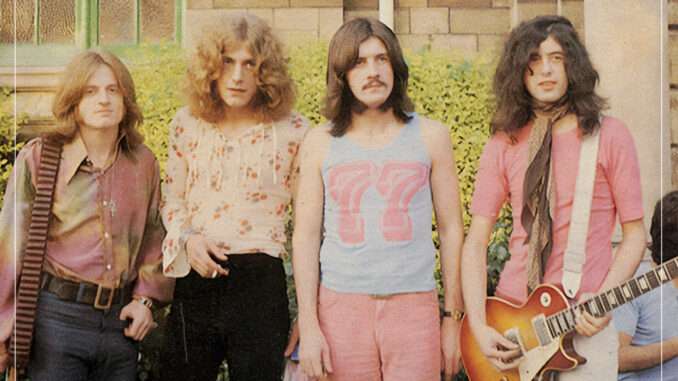
By 1973, Led Zeppelin was not merely a popular rock band—they were a phenomenon. Fresh off the success of their album Houses of the Holy, Robert Plant, Jimmy Page, John Paul Jones, and John Bonham were ready to embark on a mammoth U.S. tour: 14 stops across the nation, each a promised night of raw energy, unfiltered talent, and a near-spiritual connection with their fans.
This wasn’t just a string of shows—it was an invasion. Zeppelin didn’t travel like ordinary bands. They moved with the swagger of rock royalty, crisscrossing America aboard their own private jet, The Starship. Upon landing, they were greeted not just by fans, but by a convoy: two sleek limousines and police escorts lined up on the tarmac of Tampa International Airport, ready to whisk them to their next arena-sized conquest.
The itinerary read like a roadmap of America’s most iconic cities, but one stop would cement their immortality—Tampa, Florida.
Tampa Stadium: The Night the Record Fell
On May 5, 1973, history was rewritten. The venue: Tampa Stadium. The stakes: nothing less than the all-time concert attendance record. Until that night, The Beatles’ legendary Shea Stadium performance in 1965 was the gold standard, a night when Beatlemania exploded into a 56,000-strong roar. It was an achievement many thought would remain in the realm of the impossible.
But Led Zeppelin was not content to live in the shadow of anyone—not even The Beatles.
Tickets for the Tampa show sold out at a lightning pace. By the time the band stepped on stage, a staggering 56,800 people had filled the stadium—an additional 800 fans beyond The Beatles’ mark. The sea of humanity stretched from the stage to the furthest edge of the stands, a mosaic of denim, leather, and anticipation.
The Arrival of the Rock Gods
The arrival of the band was a spectacle in itself. Tampa International Airport became a scene out of a rock-and-roll fairy tale. Their gleaming white jet taxied in, bearing the band’s name in bold letters. The moment the cabin door swung open, a Florida breeze met the four men who would, within hours, make music history.
Two limousines idled at the base of the stairway. As the band descended, uniformed police officers snapped into formation, ready to escort them through the cheering throngs that had gathered outside the airport gates. This was not the modest, almost shy arrival of The Beatles in the early ’60s. This was an unapologetic display of power and stardom—the Led Zeppelin way.
The Sound That Broke the Ceiling
When the first chords rang out that night, Tampa Stadium erupted. Robert Plant’s voice cut through the humid Florida air, Jimmy Page’s guitar howled with precision and chaos, John Paul Jones’ bass thundered beneath the surface, and John Bonham’s drumming was an unstoppable heartbeat.
The setlist was a masterclass in rock brilliance: “Rock and Roll” brought the crowd to its feet instantly, “Black Dog” had tens of thousands singing in unison, and “Stairway to Heaven” became a shared, almost sacred moment as lighters flickered in the dark.
Unlike The Beatles’ Shea Stadium performance—where screams often drowned out the music—Led Zeppelin’s sound dominated the night. By 1973, advances in sound systems allowed the music to thunder across the open-air stadium without losing clarity. Fans didn’t just hear the music; they felt it in their bones.
A Symbolic Passing of the Torch
In many ways, that night in Tampa was about more than breaking a record. It was a cultural shift. The Beatles had defined the optimistic, love-soaked pop-rock of the ’60s, but by the early ’70s, the mood had changed. The Vietnam War, political scandals, and social upheavals had darkened the national mood. People wanted their music heavier, louder, more primal. Led Zeppelin delivered exactly that.
Where The Beatles charmed with witty lyrics and perfect harmonies, Zeppelin attacked with raw power and virtuosity. The contrast between Shea Stadium ’65 and Tampa Stadium ’73 reflected how much the world—and rock music—had changed in less than a decade.
After the Record
The Tampa show became an instant legend in rock circles. Newspapers the next day hailed it as the largest single-performance crowd in history. Fans who were there wore it like a badge of honor for decades to come: I was at Tampa ’73.
For Led Zeppelin, the record was more than bragging rights. It was proof that they were not merely heirs to the throne of rock—they had taken the crown. The Beatles had ruled the 1960s, but the 1970s now belonged to Zeppelin.
The rest of the U.S. tour rolled on with the same blend of extravagance and triumph. Every city became a celebration of excess and musical mastery, but none could replicate the scale of that Tampa night. It was the perfect collision of timing, popularity, and ambition.
The Private Jet Lifestyle
Part of Zeppelin’s mystique came from their lifestyle on the road. The Starship, their Boeing 720B, was less a plane and more a flying palace. It boasted a bar, an organ, a lounge area, and bedrooms—designed for long stretches between cities and equally long nights of celebration.
The Tampa police escorts became a metaphor for their entire tour: everywhere they went, barriers fell. Stadium doors opened, crowds swelled, and records tumbled.
Why the Beatles’ Record Lasted So Long
It’s worth noting why The Beatles’ 1965 record stood for nearly a decade. In the mid-’60s, stadium concerts were still a novelty. Shea Stadium had been a daring experiment, and the logistics of filling a sports venue with a music crowd were daunting. There weren’t advanced sound systems or massive touring infrastructures to support such events regularly.
By 1973, the industry had caught up with ambition. Promoters, engineers, and bands themselves had learned how to make stadium concerts both profitable and technically feasible. Led Zeppelin had the perfect storm: the popularity, the resources, and the will to go bigger than anyone before them.
The Legacy of Tampa ’73
Even decades later, Tampa ’73 is remembered not just for the numbers, but for what it symbolized. It was the moment Led Zeppelin stepped out from under The Beatles’ long shadow and proved that the rock crown could—and would—change hands.
Music historians often debate whether the attendance record itself is the most important takeaway, or whether the greater achievement was the cultural statement it made. Either way, May 5, 1973, remains a date etched in the granite of rock history.
And somewhere, in the roar of that 56,800-strong crowd, the torch was passed.
Leave a Reply