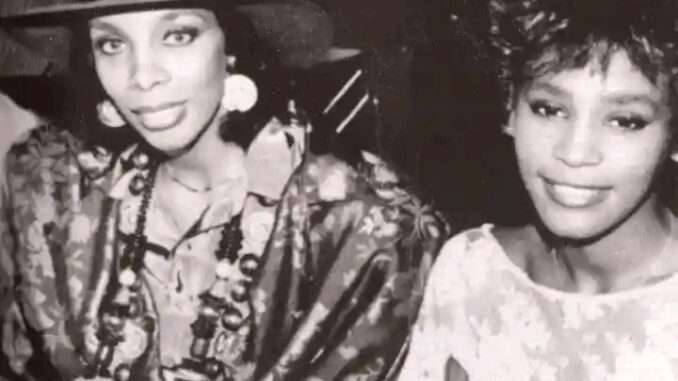
When the history of modern music is written, certain names always rise to the top: artists whose voices, artistry, and presence transcended generations. Donna Summer and Whitney Houston, two of the most iconic female vocalists of the 20th century, belong firmly in that group. Though they emerged in different eras and carried distinct styles, both left an indelible mark on music history, influencing not only their peers but also generations of singers who followed.
Summer, hailed as the “Queen of Disco”, defined the 1970s club scene with pulsing beats, lush arrangements, and her sultry yet soaring vocal delivery. Houston, who rose to prominence in the mid-1980s, redefined pop and R&B with a voice often regarded as one of the greatest in history—unparalleled in power, clarity, and emotional resonance. Their careers rarely overlapped in direct competition, yet their paths share intriguing parallels: both women navigated the challenges of fame, both revolutionized the perception of Black female singers in mainstream music, and both left legacies that continue to shape the industry long after their passing.
Donna Summer: The Queen of Disco
Donna Summer’s rise to stardom came at the height of the disco revolution in the 1970s. Born LaDonna Adrian Gaines in Boston in 1948, she grew up singing in church before moving to Europe as a young woman to perform in musicals. It was there, in Germany, that she began working with producers Giorgio Moroder and Pete Bellotte, a partnership that would change the course of popular music.
Summer’s breakout hit, “Love to Love You Baby” (1975), was unlike anything radio had ever heard before—an extended 17-minute sensual groove that combined hypnotic beats with her breathy, teasing vocals. The song not only launched her career but also solidified her as the face of disco.
From there, the hits poured in: “I Feel Love,” “Hot Stuff,” “Bad Girls,” and “Last Dance” became anthems of the era. “I Feel Love” in particular was groundbreaking—it fused electronic synthesizers with disco rhythms, laying the foundation for electronic dance music (EDM) decades before it would dominate festivals and charts.
Summer’s voice, simultaneously sultry and commanding, gave her the rare ability to make dance tracks feel both intimate and explosive. Unlike many artists boxed into disco’s short-lived trend, Summer expanded her repertoire, proving she could deliver gospel, pop, and rock-infused performances with equal conviction.
Though the “Disco Demolition Night” backlash in 1979 damaged the genre’s reputation, Summer’s star power remained. She transitioned into the 1980s with continued chart success, winning Grammys and collaborating with major producers. More importantly, she became a trailblazer for Black women in mainstream pop—a feat not easily accomplished in the era’s racially divided industry.
Whitney Houston: The Voice of a Generation
If Donna Summer was the queen of disco’s dance floors, Whitney Houston was the empress of the power ballad. Born in Newark, New Jersey, in 1963, Houston came from a lineage of musical royalty: her mother Cissy Houston was a renowned gospel singer, and her cousins included Dionne and Dee Dee Warwick. Aretha Franklin, a close family friend, was also a mentor.
Houston’s big break came when legendary music executive Clive Davis signed her to Arista Records in the early 1980s. Her debut album, “Whitney Houston” (1985), catapulted her to instant stardom, thanks to hits like “Greatest Love of All” and “How Will I Know.” The record showcased her staggering vocal range—crystal-clear high notes, effortless runs, and a belting power that left listeners spellbound.
Her follow-up album, “Whitney” (1987),made history when it debuted at number one on the Billboard 200, a first for a female artist. Singles like “I Wanna Dance With Somebody” cemented her reputation as a crossover star who could dominate both the pop and R&B charts.
But it was Houston’s performance of “I Will Always Love You” for The Bodyguard soundtrack in 1992 that etched her into cultural immortality. The song remains one of the best-selling singles of all time, a testament not just to its universal appeal but to Houston’s ability to make every lyric resonate with deep emotion.
Nicknamed “The Voice,” Houston redefined what it meant to be a vocalist in pop music. Her technical perfection and raw emotional delivery inspired countless artists who followed, from Mariah Carey and Céline Dion to Beyoncé and Jennifer Hudson. In fact, many contemporary singers still cite her as their ultimate vocal influence.
Different Eras, Different Styles
While both women dominated their respective decades, their artistic approaches differed dramatically.
• Donna Summer was closely tied to the disco movement, where rhythm, groove, and atmosphere reigned supreme. Her songs were made for the dance floor, her sensuality and energy perfectly capturing the spirit of the era. She was also deeply experimental, pushing boundaries with electronic production and extended mixes that defied radio norms.
• Whitney Houston, by contrast, thrived in an era where radio-friendly pop ballads and MTV visuals were king. Her music was less about the collective experience of a packed club and more about individual emotional connection. With each song, Houston could make listeners feel as though she was singing directly to them, her voice carrying both intimacy and grandeur.
Their careers also reflected different stages of the music industry. Summer’s success came when disco was still fighting for mainstream acceptance against rock’s dominance. Houston, on the other hand, rose during a period when crossover pop stars could achieve global superstardom with the backing of massive record labels and the new promotional power of music videos.
Shared Challenges
Despite their accomplishments, both women faced personal and professional struggles that mirrored the difficulties often encountered by Black female artists in the music industry.
Donna Summer at times felt trapped by the “disco queen” label, even as she sought to diversify her artistry. She also faced controversy later in her career, particularly around alleged comments regarding the LGBTQ+ community—an audience that had been among her most devoted supporters.
Whitney Houston, meanwhile, battled with the pressures of fame, substance abuse, and the scrutiny of her personal life. Her highly publicized marriage to Bobby Brown and her later struggles often overshadowed her artistry in the media, a harsh reminder of how unforgiving the spotlight could be.
Yet, despite these challenges, both women demonstrated remarkable resilience. They continued to perform, to inspire, and to remind the world why their voices mattered.
Lasting Legacies
Today, Donna Summer and Whitney Houston are remembered as titans of their craft. Summer’s innovations helped birth modern dance and electronic music, while Houston’s vocal template remains the gold standard for aspiring singers.
• In 2013, Houston was inducted posthumously into the Grammy Hall of Fame, and in 2020, she was inducted into the Rock and Roll Hall of Fame.
• Donna Summer also received posthumous Rock Hall honors in 2013, solidifying her role as not just a disco icon but a music pioneer.
Both women’s influence is unmistakable in today’s music landscape. The thumping basslines and synth-driven production that dominate pop and EDM owe much to Summer’s pioneering sound. Meanwhile, virtually every reality singing competition contestant who attempts a big ballad owes a debt to Houston’s vocal style.
Two Icons, One Legacy of Greatness
In comparing Donna Summer and Whitney Houston, it is tempting to ask who was greater. But the truth is, such a comparison misses the point. Each woman thrived in her own space, shaping music in ways that reflected her era while transcending it at the same time.
Donna Summer gave the world the soundtrack to liberation, a disco-fueled celebration of love, freedom, and expression. Whitney Houston gave the world a voice, a sound so flawless and powerful it remains unmatched.
Both women stood as reminders of the power of music to unite, to inspire, and to endure. And while their careers were distinct, their shared legacy is clear: they were, and always will be, among the greatest to ever step on stage.
Leave a Reply