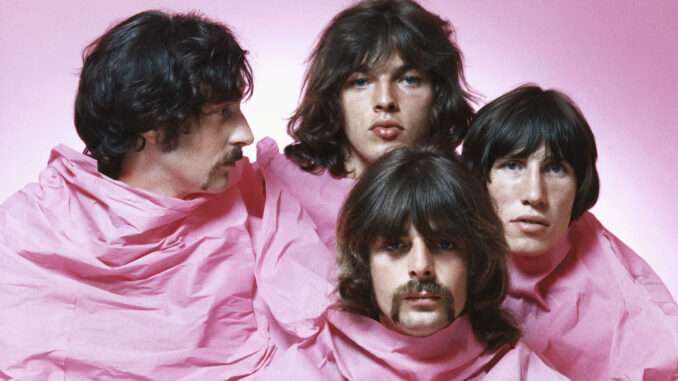
Few bands have reinvented themselves as completely—or as successfully—as Pink Floyd. Each era marked a leap into uncharted sonic territory, from their psychedelic beginnings with Syd Barrett to their conceptual masterpieces under Roger Waters, and later the widescreen guitar-driven soundscapes led by David Gilmour.
The Barrett Years: Psychedelia and the Birth of Space Rock
Formed in mid-’60s London, Pink Floyd took their name from bluesmen Pink Anderson and Floyd Council, a nod to the American music they loved. Architecture students Roger Waters, Rick Wright, and Nick Mason teamed with art-school visionary Syd Barrett, whose eccentric songwriting and charisma powered their 1967 debut The Piper at the Gates of Dawn. With kaleidoscopic tracks like Astronomy Domine and Interstellar Overdrive, the album defined British psychedelia and broke into the U.K. Top 10.
But fame came fast, and Barrett’s mental health collapsed just as quickly. His erratic behavior—often freezing onstage—led the band to bring in guitarist David Gilmour. By 1968, Barrett was gone, leaving Floyd without their leader but with a determination to evolve.
Searching for Direction: 1968–1972
The transitional years were restless and experimental. A Saucerful of Secrets (1968) hinted at new directions, while soundtracks (More, Obscured by Clouds) and the half-live, half-experimental double LP Ummagumma built a cult following. Collaborating with designer Storm Thorgerson’s Hipgnosis, the band also established its striking visual identity.
Albums like Atom Heart Mother (1970) and Meddle (1971) pushed their sound further, the latter laying the groundwork for what came next: a monumental breakthrough.
Dark Side and the Rise of Conceptual Epics
In 1973, The Dark Side of the Moon changed everything. With pristine production, expansive soundscapes, and Waters’ lyrics exploring madness, memory, and mortality, it became a cultural milestone. Fueled by the hit single Money, it topped charts worldwide and remained on the Billboard 200 for an unprecedented 741 weeks.
Floyd followed with Wish You Were Here (1975), a moving tribute to Barrett, then sharpened their social commentary on Animals (1977). The tensions of that era exploded during the Animals tour, when Waters infamously spat at a heckler in Montreal—a moment that inspired the rock opera The Wall (1979). Co-produced with Bob Ezrin, The Wall was both a massive commercial hit and a cultural touchstone, yielding Another Brick in the Wall, Pt. 2 and spawning legendary stage shows and a 1982 film.
But the success masked deep fractures. Wright was ousted during the sessions, and after 1983’s The Final Cut, Waters left for good, convinced Pink Floyd was over.
Gilmour Takes the Reins: 1987–1995
Waters’ departure ignited legal battles, but Gilmour, Mason, and eventually Wright carried on. A Momentary Lapse of Reason (1987) marked a new era, bolstered by the hit Learning to Fly and a globe-spanning tour captured on Delicate Sound of Thunder. Their follow-up, The Division Bell (1994), featured the reflective hit High Hopes and another massive world tour, preserved on Pulse. By the mid-’90s, Floyd retired from the road, leaving behind sold-out stadiums and two generations of fans.
Legacy, Reunions, and Farewells
Though the band fractured, its legend grew. Barrett passed in 2006, Wright in 2008. A surprise reunion of the classic lineup at 2005’s Live 8 was brief but unforgettable. Gilmour and Mason later crafted The Endless River (2014), drawn from Wright’s final recordings.
The Floyd legacy has since been celebrated with lavish reissues, from The Early Years box set (1965–1972) to The Later Years (1987–2019). In 2022, Gilmour and Mason released “Hey Hey Rise,” a one-off single supporting Ukraine—the first new Floyd track in nearly three decades.
And in 2025, fans witnessed a definitive restoration of Pink Floyd: Live at Pompeii, remixed in 4K with pristine audio, a reminder of the band’s otherworldly power.
A Band Beyond Time
Pink Floyd’s music—rooted in blues but driven toward the future—has influenced generations of artists, from heavy metal bands to ambient producers. Their story is one of reinvention, conflict, and brilliance, but above all, of sound that pushed rock into the cosmos.
Leave a Reply