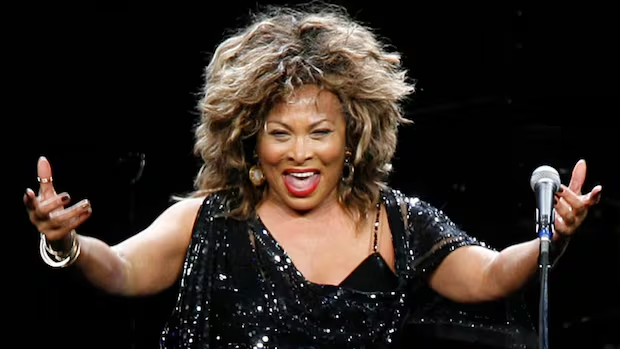
“Too Dark. Too Raw. Too Real.” — They Tried to Dim Her Light
Before the world knew her as the Queen of Rock ’n’ Roll, Tina Turner was told she didn’t fit the mold.
She was “too dark” to be marketable. “Too loud” to be elegant. “Too raw” to be polished. And — perhaps the most devastating critique of all — not “pretty enough” to be a star.
But instead of fading into the background, Tina Turner did something that changed music — and society — forever.
She ignited.
With grit in her voice and fire in her soul, she sang, danced, and fought her way to global superstardom. In doing so, she proved that true beauty doesn’t come from perfection — it comes from survival.
Rising From the Shadows: Tina’s Humble Beginnings
Born Anna Mae Bullock on November 26, 1939, in Nutbush, Tennessee, Tina Turner grew up in a deeply segregated, rural community. Her early life was marked by abandonment — both of her parents left when she was young — and hardship. But even then, her natural charisma and vocal power were unmistakable.
In her teens, Tina moved to St. Louis, where she eventually crossed paths with musician Ike Turner. When she grabbed the microphone during one of his performances, she stunned the room. Her voice wasn’t delicate or trained — it was electric. Powerful. Visceral.
She was renamed Tina Turner, and a star was born — but not yet free.
Fame — and the High Cost Behind It
As part of the Ike & Tina Turner Revue, Tina helped create hits like “Proud Mary”, “River Deep – Mountain High”, and “A Fool in Love”. Their performances were explosive, unforgettable — and grueling. Behind the scenes, Ike Turner was abusive, manipulative, and controlling.
Tina endured years of violence, trauma, and psychological torment. But when she finally left Ike in 1976, she left with 36 cents and a gas card — and nothing else. She gave up everything but her name, the only thing she fought to keep in the divorce.
That name — Tina Turner — would eventually be etched into the rock ‘n’ roll hall of fame, and into the hearts of millions.
Reinvention and Rebirth: Tina’s Solo Comeback
In the early 1980s, Tina Turner was a 40-something Black woman trying to restart her career in a youth-obsessed, male-dominated industry. She was repeatedly told that her time had passed, that she was too old, too Black, too “unfeminine” to ever be a leading star again.
But Tina didn’t just stage a comeback — she launched a cultural revolution.
Her 1984 album “Private Dancer” exploded onto the scene. With hits like “What’s Love Got to Do with It”, “Better Be Good to Me”, and the title track “Private Dancer,” Tina Turner became a household name all over again — this time, on her own terms.
- “What’s Love Got to Do with It” became her first and only No. 1 Billboard hit.
- She won four Grammy Awards that year.
- The album went multi-platinum and sold over 10 million copies worldwide.
She was not just back — she was bigger than ever.
Redefining Beauty, Power, and Womanhood
Tina Turner didn’t just redefine rock music — she redefined what it meant to be a Black woman in the public eye.
For decades, mainstream beauty standards glorified whiteness, daintiness, and passivity. Tina Turner shattered all of that. She was bold, unapologetic, and intensely powerful — both onstage and off.
She didn’t try to soften her voice, tame her moves, or bleach her image to fit in. She made the world adjust to her. And by doing so, she became a symbol of resilience for countless women who had been told they were too much or not enough.
Tina once said:
“My legacy is that I stayed on course… from the beginning to the end, because I believed in something inside of me.”
That belief — in her worth, her power, and her story — was her greatest act of rebellion.
A Global Icon and Trailblazer
Throughout the late 1980s and ’90s, Tina Turner became one of the biggest global touring acts of all time. Her concerts drew millions. Her performances were electric. Her presence was magnetic.
She starred in the cult-classic film “Mad Max Beyond Thunderdome” alongside Mel Gibson, showing the world that she could not only sing — she could act, lead, and dominate any medium she touched.
In 1993, her life story was turned into the biopic “What’s Love Got to Do with It,” starring Angela Bassett and Laurence Fishburne. The film highlighted the brutal reality of her abusive relationship with Ike and introduced her story to a new generation.
Tina Turner’s Legacy: Beauty in Survival
Tina Turner wasn’t just a superstar. She was a survivor. A warrior. A living embodiment of strength.
- She broke racial and gender barriers.
- She survived domestic abuse and reclaimed her voice.
- She proved that age, color, or background don’t define success — perseverance does.
In a culture that often rewards the polished and the perfect, Tina Turner showed us the power of being real. Of being “too much.” Of surviving, and shining.
The woman once dismissed as “too unattractive” became a symbol of iconic beauty, not because of her face, but because of her fire.
Tina Turner’s Passing — But Never Forgotten
Tina Turner passed away on May 24, 2023, at the age of 83. The world mourned not just a music legend, but a woman who inspired millions with her unshakable spirit and defiant grace.
From Beyoncé to Mary J. Blige, from Oprah Winfrey to Lizzo, her influence continues to ripple through the worlds of music, fashion, and feminism.
Her life remains proof that:
“You don’t have to be perfect to be powerful — you just have to be you.”
Long Live the Queen
Tina Turner didn’t ask for the crown — she earned it. Through grit, grace, and unbreakable will, she transformed a world that once rejected her and became one of the greatest performers of all time.
She wasn’t too raw — she was real.
She wasn’t too dark — she shined.
She wasn’t too much — she was just enough to change everything.
#TinaTurner #QueenOfRock #BlackWomenInMusic #Resilience #WhatLoveGotToDoWithIt #TinaTurnerLegacy #OnThisDay #WomensHistory #MusicLegends
Leave a Reply