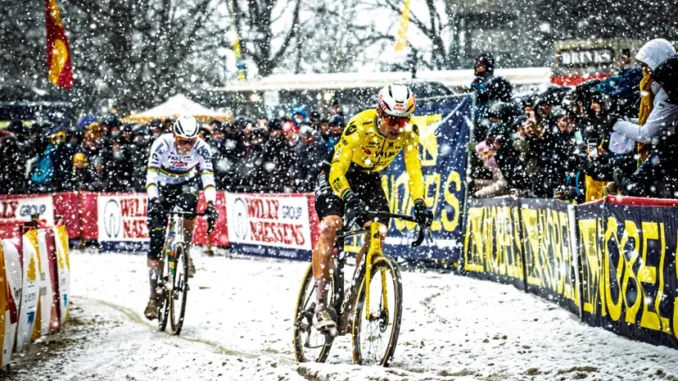
Cyclocross risk has returned to the centre of the winter conversation following Wout van Aert’s latest serious crash and the abrupt end of his season. High-profile incidents tend to sharpen scrutiny of the discipline, particularly during the intense festive period.
Inside Alpecin–Premier Tech, however, there has been no sense of alarm. For team manager Christoph Roodhooft, crashes are not a cyclocross-specific problem, nor something that can be selectively avoided. They are an inherent part of elite cycling, regardless of surface, discipline, or time of year.
“You Can Run Risks Anywhere”
Speaking to Wielerflits, Roodhooft offered a characteristically blunt assessment of danger in professional racing.
“In the end, you can run risks anywhere, even in training,” he said. “You can say that there is a competitive aspect, and that is, of course, true. But if, as a rider, you want to avoid risks everywhere, then there is really only one solution: stay indoors.”
The comment was not aimed at any particular rider or team, but it resonated in a winter when cyclocross safety has again come under scrutiny. Roodhooft’s position is clear: risk is a constant to be managed, not something that can be eliminated through selective fear or withdrawal.
Dominance Without Complacency at Alpecin–Premier Tech
That pragmatic mindset has underpinned an exceptional Christmas period for Alpecin–Premier Tech. Across the festive block, the team captured almost every elite men’s cyclocross victory, a run of form that nevertheless surprised even those inside the organisation.
“The past few weeks have exceeded our own expectations,” Roodhooft admitted.
Importantly, the success was not dependent solely on Mathieu van der Poel’s familiar dominance. In races where the world champion was absent, both Tibor Del Grosso and Niels Vandeputte seized their opportunities.
“Somewhere we had hoped for one standout result for Del Grosso and one for Vandeputte,” Roodhooft explained. “But they both won two races, which is very good.”
Rather than superiority, the internal takeaway was efficiency. “They struck at the right moments, which is not always easy.”
Tibor Del Grosso and the Next Generation
Among those results, Del Grosso’s emergence stood out most clearly. Yet Roodhooft was careful to avoid premature conclusions about the young rider’s ceiling.
“Whether Tibor can actually grow to that level, we will have to wait and see,” he said. “But there is something there.”
According to Roodhooft, the difference between frequent winners and strong riders often lies beyond measurable performance data. “Riders who win a lot often have a certain X-factor. And that Tibor has that, you cannot deny.”
That quality places Del Grosso firmly among the leading riders of his generation. “In that respect, he has become the challenger to Thibau Nys.”
Age remains a crucial factor in the assessment. “It has been a long time since we have had such a talent at that age in the team. That can only be a good thing.”
Van der Poel, Winter Form, and Measured Expectations
Despite the accumulation of wins, Roodhooft resisted drawing direct conclusions between cyclocross dominance and spring readiness on the road.
“The relevance of winning all those races is something different from being completely in order or good enough for the spring,” he said.
Victory, in his view, does not automatically signal completeness. “Just because he dominates these races now does not mean that he is in order in every respect. And vice versa, if he had lost a race, that also would not have meant that he is not good.”
Within the team, there was no sense of overreaction in either direction. “It was simply as it should be. Beyond that, I did not see anything special with Mathieu.”
Risk Accepted, Not Dramatised
That same philosophy extends to crash risk, even in a winter shaped by serious incidents elsewhere in the peloton. For Roodhooft, there is little value in singling out cyclocross as uniquely dangerous.
“You can run risks anywhere,” he reiterated, whether in cyclocross, road racing, or training.
The response is not avoidance, but balance. Van der Poel’s winter programme, for example, remained compact, with sufficient recovery built in between races. “His cross campaign was compact, but in between, he was also able to take his rest.”
The wider takeaway from Roodhooft’s remarks is realism rather than indifference. Crashes remain part of elite cycling. Dominance does not guarantee perfection. And risk, whether feared or accepted, cannot be engineered out of the sport.
Sometimes, as he dryly suggested, the only way to avoid it entirely is not to race at all.
FAQ
Why is cyclocross risk being discussed again this winter?
The conversation has intensified following Wout van Aert’s season-ending crash, which has renewed debate about safety in winter racing.
What is Christoph Roodhooft’s view on crash risk?
Roodhooft believes risk exists everywhere in elite cycling, including training, and cannot be fully avoided. He argues it must be managed rather than eliminated.
How has Alpecin–Premier Tech performed this cyclocross winter?
The team has enjoyed a dominant festive period, winning nearly every elite men’s race, with success shared across multiple riders.
Who is Tibor Del Grosso, and why is he significant?
Del Grosso is a young Alpecin–Premier Tech rider whose recent wins mark him as a leading talent of his generation and a challenger to Thibau Nys.
Does cyclocross dominance guarantee spring success for Van der Poel?
No. Roodhooft stresses that winter results do not automatically translate into spring readiness and should not be overinterpreted.
Leave a Reply