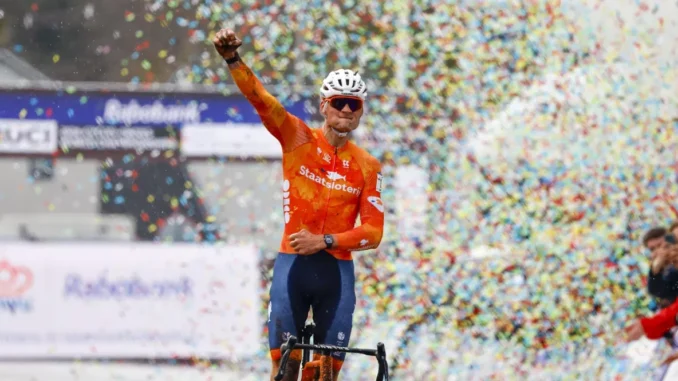
Mathieu van der Poel’s record-breaking eighth world title in cyclocross has reignited one of the sport’s most enduring arguments: who is the greatest cyclocross rider of all time?
Not everyone is convinced the answer is settled. Roger De Vlaeminck, a four-time Paris–Roubaix winner and one of cycling’s most outspoken legends, has firmly rejected the idea that Van der Poel’s growing list of rainbow jerseys alone secures that status.
Speaking to Het Nieuwsblad, De Vlaeminck argued that comparing riders across eras is far more complicated than counting world titles. He insisted that changes in competition, race dynamics and depth of the field make it impossible to flatten cyclocross history into a single ranking.
Now 78, De Vlaeminck covered a wide range of topics in the interview, beginning with a brief reflection on a New Year’s night car accident before turning his attention to modern cyclocross and today’s peloton. The Belgian escaped serious injury after leaving the road and ending up in a ditch, later describing himself as fortunate.
“Bloody hell, I was lucky,” De Vlaeminck said, stressing his relief that no one else was hurt. “What a relief that I did not make other victims.”
He also accepted responsibility for the incident. “I will say one thing about it. The crash was my own fault.”
His partner, Peggy Breunig, later clarified one point about the aftermath. “For the avoidance of doubt, Roger took a negative alcohol test,” she said.
The conversation sharpened when it turned to Mathieu van der Poel, whose eighth cyclocross world championship title moved him past Erik De Vlaeminck, Roger’s brother and the previous record holder. Asked directly whether that achievement now makes Van der Poel the greatest cyclocross rider in history, De Vlaeminck did not hesitate.
“Bloody hell, no. Not by a long shot.”
De Vlaeminck was careful to say his stance was not a criticism of Van der Poel’s talent. Instead, he pointed to the context surrounding world titles, particularly the strength and nature of competition in earlier generations. As an example, he referenced his brother Erik’s career, which was cut short.
“With Erik it was over at 28, worn out by his foolishness. How many more titles could he not have won?” he said, before listing riders from previous eras to underline how misleading simple statistics can be. “And may I list them. Renato Longo, Rolf Wolfshohl, Albert Van Damme, Peter Frischknecht, Erik, me. Those were different men than now.”
While sceptical of the “greatest ever” label, De Vlaeminck did single out Thibau Nys as the rider he most enjoys watching in today’s cyclocross scene. Rather than inevitability, it is competitiveness that still draws his admiration.
“He is good. Not the best, but good. I like watching him. He always fights,” De Vlaeminck said. “If you can stay in Van der Poel’s wheel for three, four laps, then you are not bad. Nys can do that. I am a supporter.”
That generational scepticism extended to modern road cycling as well, even as De Vlaeminck acknowledged the quality of the current stars.
“Of course Van der Poel, Evenepoel and Pogačar are good riders, but when I watch them I cannot enjoy it,” he said. “I want to ride, to race against those guys, beat them the way I sometimes could beat Merckx.”
Racing against Eddy Merckx, De Vlaeminck added, set a benchmark unlike any other. “Merckx, man, he was such a strong person. Do you know I was sometimes afraid of him. It hurt, just sitting in his wheel.”
He closed the conversation in his familiar half-joking, half-defiant tone, reminding readers of his own record.
“And still I won 512 races. 512,” De Vlaeminck said. “Do you want me to list them all?”
Leave a Reply