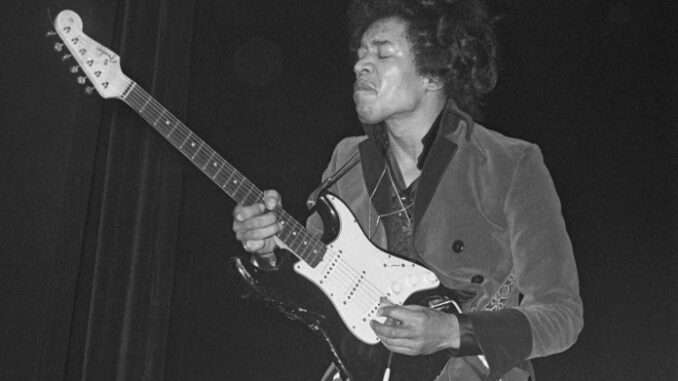
In the ongoing debate over where heavy metal truly began, a bold new claim has stirred the pot: Jimi Hendrix’s 1966 version of “Hey Joe”—not Black Sabbath—is argued by music journalist Jason Schneider to be heavy metal’s real genesis. In a provocative interview with Booked on Rock, the author of That Gun in Your Hand: The Strange Saga of ‘Hey Joe’ and Popular Music’s History of Violence asserts that Hendrix’s explosive studio approach planted the seeds for an entire genre.
Schneider’s Controversial Thesis
Traditionally, Black Sabbath—formed in Birmingham in 1968—is credited as the father of heavy metal, with their dark aesthetic and pulverizing riffs paving the way. But Schneider challenges this orthodoxy, pointing to a much earlier spark.
“If you want to trace the origins of heavy metal back to anything, that’s where I would go,” Schneider says, referencing Hendrix’s raw, overdriven sound captured during the Hey Joe sessions
He describes how Hendrix cranked his amp to maximum, demanding an unheard-of level of volume and distortion in the studio. Engineers had never encountered such sonic intensity, but Hendrix refused to dial it back — a gesture Schneider believes prefigures metal’s signature aggression.
What Was So Groundbreaking About Hey Joe?
Recorded in late 1966, Hey Joe marked Hendrix’s UK debut and introduced his visceral sound to mainstream listeners. And the recording wasn’t just loud — it upended expectations.
By pushing amplification and feedback into new territory, Hendrix didn’t just play music—he redefined how the electric guitar could scream. As Schneider argues, that act of rebellion was the spark igniting what we now know as heavy metal’s tone and ethos
Broader Context: Roots of Heavy Metal
To appreciate why this is controversial, we need to consider how the genre is traditionally traced:
- 1950s Blues & Rock laid the groundwork. Artists like Muddy Waters and distortion pioneers like Link Wray paved the early sonic path .
- 1960s Proto-Metal Bands like Cream, The Yardbirds, Steppenwolf, and Blue Cheer began cranking riffs and slowing tempos — forming the early heavy sound
- Heavy Metal Naming: The term itself surfaced in music criticism by 1968–70—used in Rolling Stone and by Chas Chandler referencing Hendrix performances —but formal application to music took hold with bands like Sir Lord Baltimore and Humble Pie
- Black Sabbath’s Arrival: Their self-titled 1970 debut album and Paranoid are widely regarded as defining heavy metal—both musically and thematically
What Fans and Historians Think
Online discussions reflect a deep divide:
“I think it’s most accurate to say that Jimi, Cream, Steppenwolf, Led Zeppelin etc laid the foundation. Those influences just had to come together in the right group of people … Sabbath.”
— (Reddit)
“Sabbath created metal; Hendrix, Zeppelin and Deep Purple were all pretty heavy… but Sabbath tied it all together.”
— (Reddit)
These comments underscore a prevailing sentiment: Sabbath crystallized what Hendrix and others had hinted at—creating a distinct genre. But Schneider flips that narrative by suggesting Hendrix inadvertently invented the sound, while Sabbath refined it.
Hendrix’s Revolutionary Sound in Perspective
Hendrix’s influence on heavy music is well-established. He popularized:
- Guitar feedback and wah-wah usage, shaping future distortion-heavy genres.
- Use of octavia pedal effects (doubling frequency) on tracks like Purple Haze — pushing tone into uncharted sonic territory.
- Marshall amplification abuse, influencing the tube-driven crunch that becomes a metal hallmark.
His Hey Joe sessions, as Schneider notes, were a public display of that aggression — recorded in December 1966 and released shortly after — shocking audiences and technicians alike with unfiltered power.
So: Can the Birth of Heavy Metal Be Traced?
Ultimately, Schneider’s proposition asks us to redefine what counts as “origin.” Was metal born of:
- A concept (the term itself coined by writers)?
- A sound (distortion, volume, riffs)?
- A band that embodied the genre fully (Black Sabbath)?
If Hey Joe embodied the proto-metal sound, is that enough to call it the genre’s birth?
Final Thoughts: Hendrix as Metal’s Enabler, Not Father
The argument is not necessarily that Hey Joe is a heavy metal song, but that Hendrix’s approach embodied the atmospheric, amplified voltage that would become metal’s DNA.
As Schneider puts it:
“If you want to trace the origins of heavy metal back to anything, that’s where I would go.”
— a bold claim that rewrites the first chapter of metal history.
The truth may lie somewhere in between: Hendrix catalyzed the sound, Cream and others built upon it, and Sabbath brought it into its full, dark glory.
What do you think? Did Hendrix inadvertently birth heavy metal, or was it Sabbath’s dark vision that made it real? Use #MetalOrigins and join the debate!
Leave a Reply