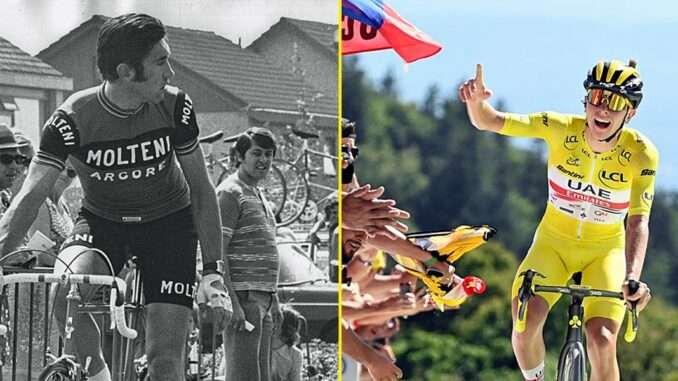
In the world of high-performance sports, few names carry the mythical weight of Eddy Merckx. Known as “The Cannibal” for his voracious appetite for victory, Merckx dominated professional cycling like no other. From the late 1960s through the 1970s, he carved out a legendary career, amassing 525 victories, including five Tour de France titles, five Giro d’Italia crowns, and a commanding presence in one-day Classics. He wasn’t just a cyclist—he was a cultural icon, a symbol of grit, relentless ambition, and utter dominance.
Fast forward to the 2020s, and the world of cycling is undergoing a renaissance. At the heart of this new era stands Tadej Pogačar, the Slovenian prodigy who has already taken the peloton by storm with two Tour de France wins, a monument victory at Il Lombardia, and a unique blend of elegance and aggression that reminds many of a young Merckx. Now, in a symbolic and deeply resonant moment for the sport, Merckx has welcomed Pogačar into what he calls “the family”—a fraternity of the few, the elite, and the transcendent.
This passing of the torch isn’t merely ceremonial. It signals a new chapter for cycling—one defined by excellence, innovation, and a deep respect for tradition.
A Meeting of Legends
In a heartfelt interview with L’Équipe, Eddy Merckx didn’t hold back in his praise for Pogačar. The Belgian great, now 79, has seen generations of cyclists come and go. Many have tried to emulate his success, but few have come close. With Pogačar, Merckx sees something different.
“Tadej is not just a great cyclist—he’s a complete rider, like we used to be. He climbs, he time-trials, he attacks. He doesn’t wait. He races to win, not just to survive. That’s the Merckx way.”
Merckx’s embrace of Pogačar is not simply a personal endorsement; it’s an acknowledgement that the Slovenian represents a continuation of the legacy built by the all-time greats. For Pogačar, being recognized by Merckx is perhaps the highest compliment the sport has to offer.
“Being mentioned by Eddy Merckx is something I never imagined,” Pogačar said. “He is the reason so many of us started cycling. To be compared to him is an honor I’ll never forget.”
The DNA of Champions
What makes Merckx and Pogačar so alike? At first glance, the eras in which they raced couldn’t be more different—Merckx battled over gravel roads on steel bikes with toe straps and wool jerseys, while Pogačar rides wind-tunnel-tested carbon fibre machines monitored in real-time by performance analysts. But deeper examination reveals a striking similarity: an unrelenting commitment to winning, a refusal to settle, and a love for attacking.
Pogačar’s audacious solo breakaway during the 2023 Tour of Flanders and his uphill dominance in the 2024 Tour de France were reminiscent of Merckx’s bold tactics in races like Milan-San Remo or Liège–Bastogne–Liège. Both riders are students of the sport’s full palette—not specialists but generalists who aim to dominate across terrains and formats.
“When I see him attacking 50 kilometers from the finish, I see myself,” Merckx said with a smile. “That’s the cycling I love.”
Innovation Meets Tradition
Beyond their racecraft, both Merckx and Pogačar represent innovation within their respective contexts. Merckx was known for his meticulous attention to detail, whether it was his diet, bike setup, or training methods. He worked closely with mechanics to perfect his machines and was an early adopter of wind resistance studies.
Pogačar brings that same curiosity into the modern world. His UAE Team Emirates operation is among the most technologically advanced in the peloton, equipped with cutting-edge data analytics, AI-assisted recovery protocols, and sophisticated training models. Yet, despite this high-tech environment, Pogačar maintains an instinctive, almost old-school approach to racing.
“You can have all the data, all the watts—but when the legs feel good, you go. That’s the most important thing,” he told Cycling News after his 2024 Paris-Nice victory.
This hybrid of instinct and information is redefining what a modern rider can be. Like Merckx, Pogačar innovates within tradition, respecting the roots of the sport while embracing tools that push the limits of human performance.
The Rise of Slovenia: A New Powerhouse
Eddy Merckx came from Belgium, a country where cycling is religion. Roads are lined with fans, cobbles are sacred, and champions are revered. Pogačar hails from Slovenia, a nation that, despite its small size, has produced a generation of cycling stars, including Primož Roglič, Matej Mohorič, and Jan Tratnik.
Slovenia’s rise in the cycling world mirrors the kind of disruptive excellence that Merckx himself ushered in decades ago. While traditional cycling powers like Italy and France still produce strong riders, it is Slovenia that has become the surprise superpower of the modern era. And leading that charge is Pogačar, now seen as a global ambassador for the sport.
Merckx has noted this with admiration:
“Slovenia is writing a new story in cycling. And Tadej is the author of its greatest chapters so far.”
Legacy in Motion
One of the most compelling aspects of the Merckx-Pogačar connection is the theme of legacy. Merckx’s greatness is set in stone, but he continues to shape the sport through mentorship, business ventures (including his bike brand), and public commentary. Pogačar, still only in his mid-20s, is writing his story in real time, with each pedal stroke carrying the weight of expectation—and the promise of history.
If Pogačar can maintain his form, avoid injury, and sustain the passion that drives him, he may one day surpass even Merckx’s record in some metrics. But neither rider is particularly focused on numbers.
“Records are meant to be broken,” Merckx said. “But more than that, they are meant to inspire. Tadej is doing that already.”
A Symbolic Transition
At a recent press event in Brussels, the two riders shared the stage for a cycling charity auction. Photos of Merckx and Pogačar standing side by side—two generations of cycling greatness—quickly went viral. One image showed Merckx placing his hand on Pogačar’s shoulder, a subtle gesture that spoke volumes.
For fans, this wasn’t just a photo op. It was a symbolic passing of the torch—from the past to the present, from a pioneer to a pathbreaker. And for cycling as a sport, it was a reminder that while heroes evolve, the heart of the competition—the pursuit of excellence—remains the same.
The Story Continues
As Tadej Pogačar continues to climb mountains, challenge norms, and dazzle fans around the globe, the endorsement from Eddy Merckx serves as both recognition and responsibility. It cements his place among the sport’s elite but also charges him with the duty of honoring its traditions while pushing its boundaries.
In welcoming Pogačar to “the family,” Eddy Merckx isn’t just complimenting a rising star. He’s acknowledging a spiritual successor—someone who embodies the power, spirit, and innovation that define the very best of cycling.
And so, a new chapter begins. The Cannibal and the Conqueror, united by wheels, will, and the never-ending road of excellence.
Would you like to include a visual timeline of both riders’ major wins for your blog layout?
Leave a Reply