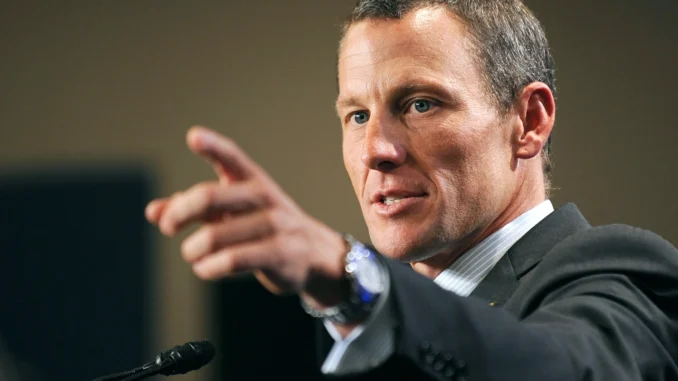
In the world of professional sports, few names ignite debate quite like Lance Armstrong. Once heralded as the ultimate comeback story—a man who conquered cancer and then dominated cycling’s most grueling event—the American cyclist became the central figure in one of the most explosive doping scandals in history. Years after being stripped of his seven Tour de France titles, Armstrong remains a polarizing symbol of victory, deception, and the relentless struggle for redemption.
Now, Armstrong is back in the headlines—not for a race, not for a confession, but for a refusal. In a recent, much-publicized interview, the disgraced cycling champion revealed that he has refused to take down the iconic yellow jerseys from his office wall. These are the very jerseys representing Tour de France titles that were formally stripped from him by the UCI (Union Cycliste Internationale) in 2012 following revelations of systematic doping throughout his career.
“I earned those,” Armstrong stated in a defiant tone. “Whatever anyone says, I was the best man on the road. The truth will be told one day.”
His words have reignited old debates, stirred new controversy, and reopened wounds in the cycling community. Is this defiance, denial, or the declaration of a man still trying to shape his legacy?
The Symbolism of the Yellow Jersey
The yellow jersey—maillot jaune—is more than just a garment in professional cycling. It is a global symbol of endurance, strategy, teamwork, and sheer human will. For over a decade, Lance Armstrong wore that jersey like a crown, achieving what many thought impossible: seven consecutive Tour de France victories from 1999 to 2005, all after a near-fatal battle with testicular cancer.
To his millions of fans around the world, those yellow jerseys told a story of resilience. To Armstrong, they were the physical representation of his second chance at life—proof that miracles were possible. And now, despite being officially stripped of them, Armstrong insists that their meaning cannot be erased by a court ruling or a doping scandal.
“They hang in my office not as trophies,” he said, “but as markers of a journey few people truly understand.”
The Fall from Grace
Armstrong’s fall from grace was spectacular and painful. For years, he denied allegations of doping, attacking journalists and whistleblowers. But in 2013, in a highly publicized interview with Oprah Winfrey, he admitted to using performance-enhancing drugs throughout his career.
The confession was seismic. Fans felt betrayed, sponsors fled, and the cycling community was forced to reckon with how complicit it may have been in allowing one of its stars to operate above suspicion. Livestrong, the cancer foundation he founded and once served as the face of, distanced itself from him.
Even then, Armstrong’s relationship with his past remained complicated. His confession was clinical and devoid of visible remorse, which many critics viewed as cold or calculated. But in private and smaller interviews, glimpses of contrition—and frustration—began to surface.
A Man Still at War with His Legacy
Armstrong’s decision to leave the jerseys on display in his office is more than just decoration—it is a battle cry. In his view, the complexity of the doping era has never been fully appreciated. He argues that the playing field was not merely level—it was entirely saturated with performance-enhancing substances.
“What I did was wrong. I’ve said that. But don’t pretend like I was the only one. I just happened to be the best at it,” he said.
That line, equal parts confession and challenge, reveals Armstrong’s enduring perspective: that his victories, while tainted, were still feats of athletic dominance. It’s a point that continues to divide the sporting world.
Some agree with him. They argue that Armstrong’s case became a scapegoat for a wider, systemic issue within professional cycling. Others remain adamant: his actions corrupted the integrity of the sport and caused irreparable damage.
Public Reaction: Polarizing and Predictable
Unsurprisingly, reactions to Armstrong’s latest statements have been mixed. Supporters praise his honesty and bravery for facing the past head-on. Critics see his behavior as yet another example of narcissism and refusal to accept full accountability.
Social media lit up after the interview aired, with hashtags like #LanceLegacy and #TourTruth trending across platforms. Former professional cyclists weighed in. Some expressed fatigue with the constant reopening of the Armstrong saga, while others welcomed a renewed conversation about doping, ethics, and forgiveness.
“This is who Lance has always been,” tweeted one former teammate anonymously. “He believes he owns the truth. But the truth was always bigger than him.”
A Legacy in Limbo
Armstrong’s career, once mythic in scale, now sits in a strange purgatory. Officially, he has no Tour de France titles. Statistically, his victories have been voided. But unofficially—emotionally, symbolically, and culturally—his influence remains enormous.
He inspired a generation of cyclists, cancer survivors, and underdogs. He also broke hearts, shattered illusions, and reminded the world that heroes are often deeply flawed.
Today, his jerseys hang in his office not as accolades, but as artifacts of one of the most complex stories in sports history. They are a mirror—reflecting greatness, deception, and perhaps, somewhere deep within, redemption.
What Comes Next?
Armstrong has hinted that a new project is on the horizon. Whether it’s a book, documentary, or advocacy campaign remains to be seen. But what’s clear is that he’s not fading quietly into the background. His podcast, The Forward, continues to draw significant audiences. His opinions on cycling, doping, and athlete wellness are sought after, whether listeners agree with him or not.
And the jerseys? For now, they remain on the wall, silently shouting a message that only Armstrong can truly define.
“I’m not trying to rewrite history,” he concluded. “But I’m also not going to pretend I wasn’t there. I was. And I still am.”
Final Thoughts
In refusing to take down those jerseys, Lance Armstrong has sparked a new phase in a conversation that has haunted cycling for over a decade. It’s not just about trophies or titles—it’s about truth, redemption, and the audacity to own one’s entire story, however messy it may be.
Love him or loathe him, Lance Armstrong refuses to be erased. His yellow jerseys may no longer be recognized by the sport’s governing bodies, but they still hold space—on a wall, in memory, and in a saga that’s far from over.
Leave a Reply