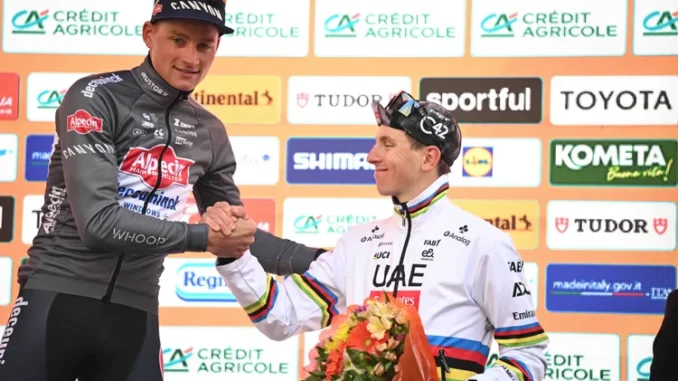
Raw power is usually enough for Tadej Pogačar to dominate almost any race on the calendar. But according to Vincenzo Nibali, Milano-Sanremo does not follow the same logic. And if the world champion wants to finally add La Classicissima to his palmarès, strength alone may once again fall short—especially against the tactical intelligence of Mathieu van der Poel.
Speaking to Bici.Pro, Nibali drew a sharp distinction between Pogačar’s overwhelming physical superiority and Van der Poel’s ability to win through timing, positioning, and restraint.
“Any race Pogačar wins, he wins through strength, not tactically,” Nibali said. “He attacks because he is stronger. But who wins with cunning and tactics? Van der Poel.”
Why modern speed has changed everything
Nibali began his analysis by pointing to how much the peloton itself has evolved. In today’s racing environment, sustained attacks are far harder than they were even a decade ago.
“The level of the peloton is extremely high now, and then there are riders who are simply out of scale,” he explained. “We used to race at an average of 42 kilometres per hour. Today it’s 47.”
That increase, Nibali stressed, is not just about training. “Those five kilometres aren’t only linked to preparation, but to the whole racing package: the bike, handlebars, saddle, seatpost, wheels, shoes, socks, shorts. Everything is more performant.”
The result is a peloton that offers little room for risk-taking. “If the average speed is 45, you need to attack at 50,” Nibali said. “And you have to hold that speed for longer because the bunch doesn’t let you go. That’s why it has become harder to get into a breakaway, and many riders just give up.”
Pogačar’s strength—and the cost it demands
Within that context, Nibali sees Pogačar as a rare exception, a rider capable of forcing races onto his own terms.
“The exception is Pogačar,” he said. “He has incredible explosiveness, then settles into his rhythm and puts everyone else into the red. And once you’re in the red, it takes a long time to recover.”
That effort, however, comes at a price. “Before you clear the lactic acid, your legs go into crisis. Sometimes it takes a week to fully recover. That’s the main problem when you race against Tadej.”
Yet it is precisely because Pogačar so often wins through force that Nibali believes Milano-Sanremo presents a unique challenge.
“Maybe his limit—if you can even call it that—is that he thinks he can manage everything with strength,” Nibali said. “At Milano-Sanremo he tries to drop everyone on the climb, without considering other ways to win—like I did, on the descent.”
The Poggio moment that decided Milano-Sanremo
Nibali was unequivocal when revisiting the decisive exchange between Pogačar and Van der Poel on the Poggio.
“When Pogačar attacked and Van der Poel stayed on his wheel, I immediately said that if Tadej wasn’t careful, the other would counterattack and leave him there,” Nibali recalled. “One second later, that’s exactly what happened—and he almost dropped him.”
For Nibali, that moment decided the race. “At the top they looked at each other, but Tadej realised the other still had enough to go clear. He nearly paid for it. In my opinion, he lost Milano-Sanremo right there.”
Van der Poel’s advantage didn’t end on the climb. “The other masterpiece came in the sprint,” Nibali added, “managed like someone who knows perfectly how to handle those situations.”
Why tactics still matter at Milano-Sanremo
Despite its length, Nibali insists that Milano-Sanremo continues to reward race intelligence over brute force.
“In Milano-Sanremo, the sprinter is always stronger,” he said. “Even after 300 kilometres, the difference isn’t that big.”
Only under very different conditions do the scales truly tip. “If you’ve done 270 kilometres with 5,000 metres of climbing, then the values level out and you might win the sprint.”
As for Pogačar, Nibali has no doubt he will keep trying. “He has a clear plan of what he wants to win,” he said. “He’ll race in his own way again, trying to drop everyone.”
But the warning remains. At Milano-Sanremo—where timing, nerve, and tactical clarity can matter more than raw watts—Pogačar may need more than strength to finally claim the Monument that continues to elude him.
Leave a Reply