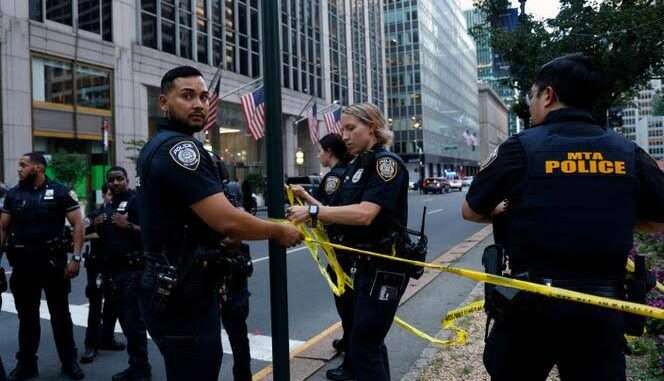
On July 28, 2025, New York City was struck by its most devastating mass shooting in 25 years when 27‑year‑old Shane Devon Tamura stormed the Midtown Manhattan office tower at 345 Park Avenue, armed with an M4-style rifle and intent on targeting NFL headquarters. The outcome was tragic and chaotic: four innocent people were killed — including off‑duty NYPD Officer Didarul Islam, security guard Aland Etienne, Blackstone executive Wesley LePatner, and a Rudin associate, Julia Hyman. Tamura turned his weapon on himself on the 33rd floor after taking a fifth victim’s life, and one other person remains critically injured .
Scene and Motive
Tamura carried out the attack in broad daylight after a cross-country drive from Las Vegas over several days. Upon arrival, he fired in the lobby before pressing upward — reportedly choosing the wrong elevator and ending up on the floor housing Rudin Management, rather than the intended NFL offices. In a handwritten suicide note, he accused the NFL of suppressing the dangers of chronic traumatic encephalopathy (CTE) and demanded his brain be studied postmortem .
The suspect had a documented history of mental illness but no significant prior criminal record. Security personnel and first responders had little time to react to his premeditated attack .
Human Toll
Officer Didarul Islam, a 36-year-old NYPD veteran born in Bangladesh, is being hailed as a fallen hero. He confronted the shooter in the lobby and sacrificed his life in the line of duty. Islam is remembered as a devoted family man with two young children and one on the way .
Colleagues Wesley LePatner and Aland Etienne, along with Julia Hyman, are mourned as respected professionals thrust into violence.
An NFL employee, seriously injured amid the chaos, remains hospitalized in stable condition. The NFL has pledged increased security measures for their offices following the tragedy .
Broader Context
This rampage follows earlier mass shootings across New York—such as the Amazura nightclub shooting in Queens, on January 1, 2025, where three to four gunmen opened fire into a crowd waiting to enter a private event. They unleashed over 30 rounds, injuring 10 teenagers, all of whom survived but remain traumatized. That incident, attributed to gang violence, spurred demands for community action and police accountability .
Crime Statistics and City Response
Despite this horrifying incident, city officials pointed to record‑low shooting numbers in the first half of 2025. Mayor Eric Adams and NYPD Commissioner Jessica Tisch reported historic declines in shootings, felony assaults, robberies, and other major crime metrics. Gun seizures exceeded 22,300 illegal firearms, with 2,600 removed in 2025 alone, contributing to a 54% reduction in shooting victims compared to early 2021, before Adams took office .
Programs like Cure Violence—which rely on community conflict mediation and intervention—are credited with a 14% reduction in shootings across NYC since 2012 and have reportedly prevented hundreds of incidents, saving lives and billions in social costs .
When Will Leaders Get Tough?
Amid calls for political action—particularly after a tragedy like this—the reality is sobering: academic research indicates mass shootings rarely shift legislative behavior. A 2025 study evaluating nearly 2,000 state legislators found no consistent change in support for stricter gun laws, even in districts directly affected by such violence .
Yet tough-on-crime rhetoric has a long history in U.S. politics—often triggering expanded incarceration rates and disproportionate effects on communities of color, with limited long-term safety gains . So when residents demand harsher enforcement, what comes next? More policing, mandatory minimums, bail expansion, or renewed investment in community infrastructures like jobs, education, mental health, and housing? Evidence suggests that voters want the latter but political narratives often default to the former .
What Now?
1. Demand Real Accountability and Reform
Residents and civic groups can pressure lawmakers to:
Increase access to mental health services.
Fund proven violence-reduction programs like Cure Violence.
Improve data transparency so communities can track which interventions work .
2. Legislate Sensibly
Rather than knee-jerk enactments, policy should:
Address loopholes around semi‑automatic and military‑style weapons.
Strengthen background checks and red‑flag laws.
Support de-escalation and community policing strategies.
3. Prioritize Prevention Over Punishment
New York’s declines in crime show that multi-agency coordination, hotspot policing, and social services matter. But such victories risk being overshadowed by crises like the Park Avenue shooting unless momentum continues.
4. Elevate Victims’ Voices
Families and colleagues of victims like Officer Islam and Wesley LePatner must be at the center of public discourse––not just as spokespeople but as stakeholders in solutions.
Final Thoughts: A Reckoning or Continued Rhetoric?
While NYC’s broader crime trends have been moving positively, the July 28 mass shooting lays bare the persistent vulnerabilities in our city’s safety net—from mental health systems to gun regulations. Leaders must step beyond symbolic gestures and race past 24-hour news cycles to deliver structural reforms.
The question remains: When will leaders stop talking tough and start acting smart?
Will future headlines read about meaningful policy change, or will we again see condemnation without consequence? The path forward demands decisive action on gun control, mental health access, and community investment—not just tough talk.
Leave a Reply