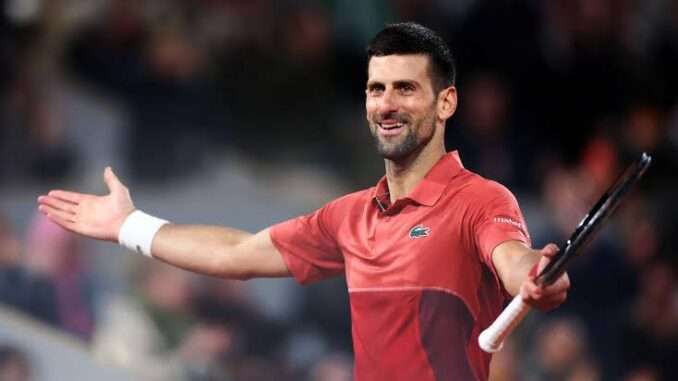
As the crisp Alpine air swirled around the picturesque courts of the Gonet Geneva Open, tennis fans witnessed something special: the unmistakable spark of Novak Djokovic returning, just when it seemed to flicker. With the French Open looming on the horizon, the Serbian legend has found a much-needed boost in Geneva, silencing critics and reminding the world why he’s still a force to be reckoned with.
After a lackluster and uncharacteristically turbulent 2024 season that has seen the world No. 1 struggle with form, fitness, and focus, Djokovic’s wildcard entry into the ATP 250 event in Geneva came as a surprise to many. Historically, Djokovic has rarely needed pre-Grand Slam warmups. His legacy, built on confidence, consistency, and peerless preparation, often had him skipping smaller tournaments altogether. But this year, as whispers grew louder about whether the 24-time Grand Slam champion was finally beginning to fade, Djokovic did something he’s rarely done—he reset.
A Strategic Pivot in Switzerland
It was a strategic decision, perhaps even a humble one. Geneva was never part of Djokovic’s regular schedule, but this time, it felt less like an afterthought and more like a mission. His early exit from Rome and a quarterfinal stumble in Monte Carlo had sparked doubts. In recent interviews, Djokovic admitted to not feeling himself on the court—physically or mentally.
“Sometimes, you have to take a step back to leap forward,” Djokovic said in his opening press conference in Geneva. “This year hasn’t started how I wanted, but I believe in the process. Coming to Geneva is part of that process.”
That process is beginning to bear fruit.
The Return of the Old Magic
From his first match in Geneva, Djokovic looked sharper. His footwork, which had appeared heavy in recent months, had regained its signature fluidity. His returns—a cornerstone of his game—were punishing again. And perhaps most importantly, his demeanor had changed. There was fire in his eyes, a clenched fist after a clutch winner, and even the occasional playful smile—a stark contrast from the frustrated figure we saw earlier this season.
In the quarterfinals, he dismantled Denis Shapovalov in straight sets, showing glimpses of his best form. But it was his semifinal battle against Tallon Griekspoor that truly galvanized belief in his resurgence. The match went the distance, with Djokovic digging deep to prevail in a gritty three-set thriller. The crowd roared as he raised his arms in victory, not just because he had won, but because he was back.
“This is the Novak we know,” said former world No. 3 David Ferrer, now a commentator. “He thrives on adversity. When people count him out, that’s when he comes alive.”
Building Momentum Ahead of Paris
The timing of Djokovic’s resurgence could not be better. The French Open, set to commence in just a few days, is arguably the toughest of the four Grand Slams, and Djokovic, despite his two titles at Roland-Garros, has always had to work harder for success on the Parisian clay. This year’s edition promises to be especially fierce, with Carlos Alcaraz, Jannik Sinner, and a resurgent Rafael Nadal all eyeing the Coupe des Mousquetaires.
But Djokovic, who turns 38 later this month, has made a career out of rewriting narratives. In 2021, he famously came back from two sets down in the final to defeat Stefanos Tsitsipas and claim his second French Open crown, a feat that many consider one of the greatest comebacks in Grand Slam history. And now, three years later, he’s attempting a different kind of comeback—not within a match, but within a season.
Silence the Doubters
Throughout 2024, questions have swirled around Djokovic’s motivation. Having broken nearly every significant record in the sport, from most weeks at No. 1 to most Grand Slam titles, it was fair to wonder: What more is there to prove? Djokovic’s early exits and visible frustration had many suggesting that the fire was gone.
But Geneva offered a different picture.
“I’m still hungry,” Djokovic said after his semifinal win. “People think success makes you complacent. For me, it makes me want to do more, especially when I know I’m not playing my best.”
Those words weren’t empty. On the court, Djokovic backed them up with precision and grit. Off it, he stayed longer for practice, engaged with fans, and showed a lightness in spirit that had been missing. His team, including long-time coach Goran Ivanišević, seemed rejuvenated too, smiling, laughing, and, most importantly, believing.
What This Means for Roland-Garros
So what does Djokovic’s Geneva performance really mean for Paris?
Firstly, momentum. Clay is a surface that rewards confidence and rhythm. It’s slow, demanding, and brutal on the body. For Djokovic to string together strong matches on the Geneva clay—however different it might be from Roland-Garros—is an essential foundation. Secondly, the psychological edge. His rivals have all had their share of doubts this season: Alcaraz has battled injuries, Sinner has lacked consistency, and Nadal is still not at full match fitness.
Now, with a potential Geneva title (his first ATP 250 title since Eastbourne in 2017) under his belt, Djokovic heads to Paris with belief restored.
And let’s not forget the intangible: legacy. With 24 Grand Slam titles to his name, Djokovic is chasing his 25th, which would push him further into uncharted territory. Roland-Garros might be Nadal’s kingdom, but Djokovic knows the terrain just as well. He’s the only man to beat Nadal twice at Roland-Garros and the only one to win each Grand Slam at least three times—records that fuel his desire for more.
The Final Word: Never Write Off a Champion
In sport, greatness is often measured in trophies. But the moments that truly define champions are those when they’re doubted—when the world begins to move on, and they choose to fight back.
Novak Djokovic has been the embodiment of resilience in his entire career. From his early battles against Federer and Nadal to becoming the most decorated player in men’s tennis history, his journey has been one of relentless pursuit.
Geneva may not carry the glamour of a Grand Slam, but this week, it offered something more valuable: a reminder that Djokovic, even in the twilight of his career, still has the tools, the tenacity, and the heart to win.
As the clay courts of Paris prepare to host the sport’s greatest spectacle, one thing is now certain—Novak Djokovic is ready.
And he’s not done yet.
Leave a Reply