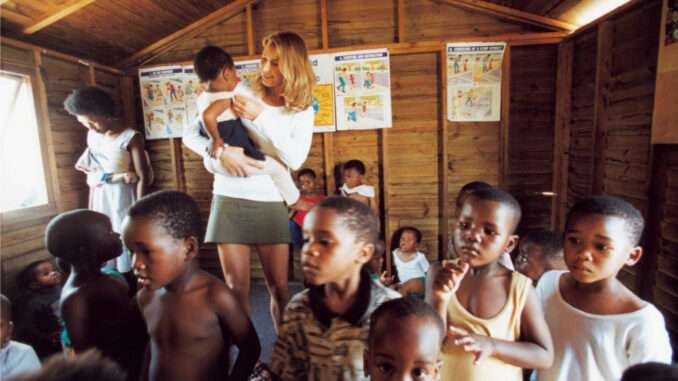
In a bold move that intertwines philanthropy with family exploration, tennis legend Steffi Graf is preparing to embark on an ambitious world tour alongside her family, with a heartfelt mission at its core. The five-time Wimbledon champion and one of the most celebrated athletes in tennis history is taking her efforts beyond the court—this time, not to win trophies, but to transform lives.
Graf’s upcoming journey spans five culturally and geographically diverse nations—South Africa, China, Russia, Canada, and Argentina. However, this isn’t just a luxurious vacation. The tour’s central aim is to amplify the reach of her charity foundation, “Children for Tomorrow,” a humanitarian organization focused on supporting the mental health of children who have experienced war, displacement, violence, and trauma.
From Tennis Court to Global Mission
Founded by Graf in 1998, Children for Tomorrow has become a significant force in the realm of child trauma therapy, focusing particularly on children who have endured the horrors of armed conflict and persecution. Based in Hamburg, Germany, the foundation provides psychotherapeutic care and tailored support to children and families from the Middle East, Sub-Saharan Africa, and Eastern Europe. Now, with this new chapter, Graf aims to personally connect with communities affected by crisis, offer on-the-ground support, and foster international partnerships.
In a recent statement announcing the tour, Graf expressed her long-standing commitment to this cause:
“The world has seen an explosion of violence and displacement in recent years. Now more than ever, our children—especially those fleeing war and terror—need healing, compassion, and hope. This journey is not only for outreach but for listening, learning, and sharing in the work of recovery.”
The Tour Itinerary: Purpose Meets Presence
The itinerary is both ambitious and symbolic. In each of the five countries, Graf and her family will engage in both public and private efforts—meeting with local leaders, educators, health professionals, and, most importantly, the children themselves.
- South Africa: The first leg of the journey will take place in Johannesburg and Cape Town, where Graf will collaborate with mental health organizations serving children in post-apartheid communities and conflict-affected regions. In the townships surrounding these cities, the focus will be on healing generational trauma and the scars of systemic violence.
- China: Graf plans to visit both urban therapy centers in Beijing and remote rural provinces where Children for Tomorrow is helping displaced ethnic minorities. The aim is to bridge the conversation between cultural trauma and modern therapy approaches.
- Russia: Despite geopolitical tensions, Graf is determined to open dialogue around child mental health in conflict zones, particularly those impacted by the ongoing refugee crisis from regions like Ukraine and Central Asia.
- Canada: Graf and her team will head to Toronto and Vancouver, where they’ll engage with Indigenous communities and migrant families. Canada is seen as a critical partner for potential funding, mental health innovation, and cross-national projects.
- Argentina: Buenos Aires and the northern provinces will host Graf’s final stops, with a focus on refugee children from Venezuela and other South American regions. Graf hopes to support the expansion of trauma therapy programs in schools and shelters.
A Family Affair
Joining Graf on the tour will be her husband, Andre Agassi, himself a tennis legend and respected philanthropist, and their two children. While the spotlight is on the mission, the tour also doubles as a once-in-a-lifetime bonding experience for the family, rooted in shared values of empathy, service, and global awareness.
Agassi, who runs the Andre Agassi Foundation for Education, commented in a joint press release:
“Our family believes that legacy is more than trophies. It’s about leaving the world better than you found it. This journey represents that for us—and for those whose voices are often unheard.”
Their children, both in their teens, are also expected to participate actively—interacting with local youth, volunteering at partner organizations, and documenting their experiences.
Advocacy Through Storytelling
What makes this tour especially poignant is its emphasis on advocacy through storytelling. Graf will be partnering with several international media houses and documentary filmmakers to capture the experiences of the children they meet and share them with a global audience. The goal is not to showcase trauma, but resilience, and to humanize the numbers often associated with war and displacement.
Each country will contribute to a mini-series, culminating in a feature-length documentary tentatively titled “Beyond Borders: Children for Tomorrow”. Graf will serve as executive producer, and proceeds from its eventual release will go directly into the foundation’s child therapy programs.
Spotlight on the Middle East
Although the itinerary lists five countries, a significant focus will remain on the Middle East, where Children for Tomorrow continues to serve large numbers of Syrian, Iraqi, Afghan, and Palestinian children. Graf hopes that the international attention gained from the tour will lead to increased funding and cooperation for these long-running efforts.
“Some of our most heartbreaking and hopeful stories come from these regions,” Graf explained. “We may not be traveling there directly this time, but they remain at the heart of everything we do.”
Mental Health at the Forefront
Graf’s efforts are coming at a crucial time. According to the UNHCR, over 43 million children worldwide have been displaced by conflict as of 2024. Of those, over 75% show signs of trauma-related distress, yet very few have access to qualified mental health care.
Children for Tomorrow seeks to change this through
- Long-term psychotherapy for children and adolescents
- Family integration support programs
- Trauma-informed training for local educators and caregivers
- Advocacy for better governmental and international policies regarding refugee care
With mental health often still stigmatized or overlooked in humanitarian contexts, Graf’s hands-on involvement helps break down taboos and build momentum toward a more compassionate, scientifically grounded approach.
A Legacy Off the Court
Steffi Graf’s legacy as an athlete is unquestionable—22 Grand Slam singles titles, a Golden Slam in 1988, and over 377 weeks as world No. 1. Yet, her post-tennis life is increasingly becoming a beacon of social responsibility.
By spending her resources, time, and voice on the well-being of children affected by trauma, Graf is crafting a new legacy—one not measured in trophies, but in lives touched, healed, and empowered.
What’s Next?
The tour is scheduled to begin in July 2025, with live coverage, social media updates, and community events planned at every stop. Graf has also opened up volunteer opportunities for supporters wishing to engage in various countries through Children for Tomorrow’s partner programs.
Her closing remarks at the press conference summed it up best:
“We can’t fix the world overnight. But if we can heal even one child, we’ve made a start.”
Leave a Reply