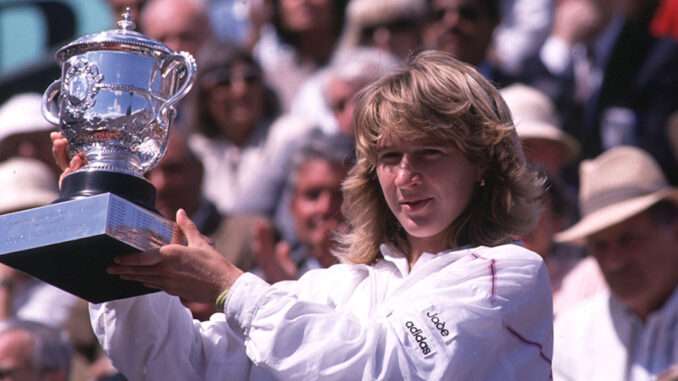
In the world of tennis, few moments shine as brightly as Steffi Graf’s 1988 US Open victory. It wasn’t just another Grand Slam win. It was a coronation, a defining performance that etched her name alongside the sport’s greatest legends. By defeating Argentina’s Gabriela Sabatini in a gripping three-set final — 6–3, 3–6, 6–1 — Graf claimed her first US Open title, her fifth career major, and sealed one of the most extraordinary achievements in tennis history: the calendar-year Grand Slam.
But Graf didn’t stop there. The US Open title was also the fourth jewel in her unprecedented and still unmatched Golden Slam — all four majors plus the Olympic gold medal in a single season. At just 19 years old, Graf not only rewrote tennis history, she redefined the very limits of athletic excellence.
A Final Unlike Any Other
The 1988 US Open final stood out even before a ball was struck. For the first time in 15 years, the women’s final didn’t feature an American player. The legendary Martina Navratilova, who had dominated the tournament and was the two-time defending champion, had been ousted in the quarterfinals. That opened the door for new faces to step into the spotlight — and few shone brighter than Graf and Sabatini.
Sabatini, with her graceful style and tactical versatility, was no easy opponent. The Argentine star pushed Graf to the limit, especially in the second set where she broke through with aggressive shot-making and composure under pressure. For a brief moment, the match teetered on the edge of uncertainty. But when the third set began, Graf found another gear. With unrelenting groundstrokes, blistering forehands, and her signature mental fortitude, she surged ahead, dismantling Sabatini’s rhythm and closing out the match decisively.
The victory didn’t just secure a trophy — it confirmed what the tennis world already suspected: Steffi Graf was building a dynasty.
Completing the Grand Slam
Graf’s win at Flushing Meadows completed her sweep of the year’s four Grand Slam tournaments — the Australian Open, the French Open, Wimbledon, and now the US Open. Only two women before her had ever achieved this calendar-year Grand Slam: Maureen Connolly in 1953 and Margaret Court in 1970. To join such an exclusive club was staggering enough. But Graf wasn’t just replicating history; she was about to transcend it.
The Grand Slam requires near-perfection across vastly different surfaces and atmospheres: the hard courts of Australia and New York, the clay of Paris, the grass of Wimbledon. Few players can adapt so seamlessly, yet Graf thrived. She wasn’t just winning — she was dominating. Her 1988 season was a masterclass in versatility, athleticism, and relentless focus.
The Golden Slam: A Record Untouched
What made 1988 truly historic wasn’t just the Grand Slam. It was the Golden Slam. Just weeks after her US Open victory, Graf traveled to Seoul for the Olympic Games. There, she captured the gold medal in women’s singles, completing the only Golden Slam in tennis history.
To this day, no other player — male or female — has matched the feat. Plenty have dreamed, many have come close, but only Graf sealed all five titles in one calendar year. It’s the ultimate symbol of dominance, and it remains one of the most awe-inspiring records in all of sports, not just tennis.
A Teenager’s Rise to Tennis Royalty
Perhaps the most remarkable part of this story is Graf’s age. At just 19 years old, she wasn’t supposed to be this dominant, this composed, this complete. Yet she approached each match with maturity beyond her years. Her athleticism was unmatched, her groundstrokes powerful, her footwork flawless. Beyond the physical tools, it was her mental toughness that truly set her apart.
Graf never looked rattled, even when Sabatini pressed hard in the second set of the final. She had an uncanny ability to reset, to treat every point as an opportunity, and to close the door when victory was within reach. This wasn’t just raw talent — it was the foundation of greatness.
Breaking Away from an Era of American Dominance
The 1988 US Open final also symbolized a changing of the guard. For decades, American women had dominated the tournament, from Chris Evert to Martina Navratilova. Graf’s triumph signaled a new era where the sport became truly global, with stars rising from across the world.
Graf herself embodied this shift. A teenager from West Germany, she carried the hopes of a nation still searching for its tennis identity on the women’s side. With every victory, she not only inspired fans worldwide but also reshaped the landscape of women’s tennis.
Cementing Her Legacy
Graf’s 1988 season didn’t just make her a star — it made her immortal in the sport’s history books. The Golden Slam remains her most iconic achievement, but it was the US Open victory that served as the keystone of it all. Without that gritty, resilient performance against Sabatini in New York, the Golden Slam would have been incomplete.
In the years that followed, Graf would go on to collect a total of 22 Grand Slam singles titles, ranking her among the most decorated champions in tennis history. Yet when fans and historians look back, 1988 shines brightest. It was the year she ascended from prodigy to legend, from contender to conqueror.
The Match That Defined an Era
Looking back, the 1988 US Open final wasn’t just a tennis match — it was a cultural moment. Millions watched as a teenager from Germany carved her place in history. For aspiring athletes, it became a symbol of what dedication, skill, and fearlessness could achieve. For tennis fans, it was a reminder of why they love the sport: the drama, the rivalries, the brilliance of performance under pressure.
Sabatini, though on the losing side, also deserves recognition. She pushed Graf to her limits and played her role in one of the most memorable finals in Open Era history. Their rivalry would continue to captivate audiences for years, but this match was its defining chapter.
Why Graf’s 1988 US Open Still Matters
Even decades later, Graf’s victory resonates. In today’s era of tennis superstars — Serena Williams, Roger Federer, Rafael Nadal, Novak Djokovic — the Golden Slam remains a distant dream. It’s a benchmark of perfection, a reminder of the heights one athlete can reach when everything aligns: talent, discipline, health, and timing.
Steffi Graf didn’t just win the 1988 US Open. She redefined what was possible in tennis. She proved that youth could command the biggest stages, that dominance could cross surfaces and continents, and that history is written not by those who follow but by those who dare to achieve the impossible.
Conclusion
Steffi Graf’s 1988 US Open victory is more than a chapter in tennis history; it’s a masterpiece of athletic achievement. By defeating Gabriela Sabatini in a tense, dramatic final, she not only secured her first US Open title but also completed the calendar-year Grand Slam. With the Olympics still ahead, she turned that triumph into the sport’s only Golden Slam — an achievement that remains untouched.
At 19, she wasn’t just winning matches. She was building a legacy. A legacy that inspires athletes across generations and stands as one of the greatest sporting achievements of all time.
In a year filled with milestones, it was that New York night — under the bright lights of Flushing Meadows — where Steffi Graf transformed from champion to legend.
Leave a Reply