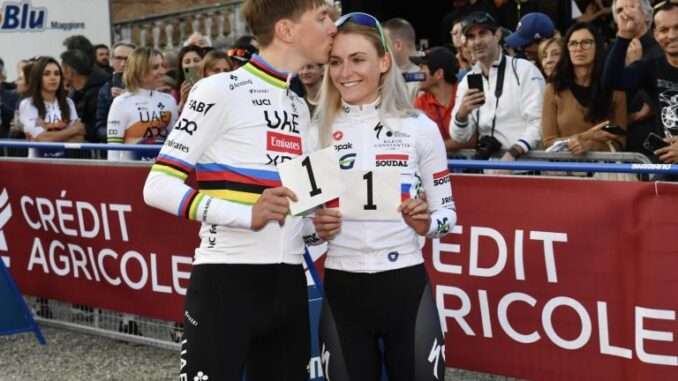
Behind every great champion stands a support system that transforms raw talent into legendary achievements. For Tadej Pogačar, the Slovenian cycling phenomenon who has dominated professional cycling with four Tour de France victories and a historic 2024 season, that support comes from two key figures: his fiancée and fellow professional cyclist Urška Žigart, and his coach Javier Sola.
Together, they form the personal and professional foundation that has enabled Pogačar to reach unprecedented heights in the sport. This comprehensive guide explores the woman who shares Pogačar’s life, the coach who revolutionized his training, and how their combined influence has shaped one of cycling’s greatest careers.
Who Is Urška Žigart? Tadej Pogačar’s Fiancée and Fellow Champion
A Champion in Her Own Right
Urška Žigart is far more than simply “Tadej Pogačar’s partner”—she is an accomplished professional cyclist who has carved out her own impressive career in women’s cycling. Born on December 4, 1996, the 28-year-old Slovenian has established herself as one of her country’s premier cyclists, competing at the highest levels of international women’s racing.
Žigart currently rides for AG Insurance-Soudal, the women’s division of “The Wolfpack,” having joined the UCI Women’s WorldTeam in 2025 on a two-year contract. Her move to this prestigious team represents a significant step forward in her professional development and reflects her ambitions to compete for victories in the sport’s biggest races.
Championship Pedigree: National Titles and International Success
Žigart’s palmares demonstrates consistent excellence at the national level and growing success internationally. She has won the Slovenian National Time Trial Championship four times—in 2020, 2022, 2023, and 2024—establishing her dominance in the discipline. In 2024, she added the Slovenian National Road Race Championship to her collection, showcasing her versatility across different race formats.
Beyond national success, Žigart has competed in some of women’s cycling’s most prestigious races. She has ridden the Giro d’Italia Donne, Tour de Suisse Women, and other major UCI WorldTour events, consistently performing at the elite level. Her international racing experience has provided valuable perspective on the demands of top-level professional cycling, which she shares with Pogačar as they navigate their respective careers.
Žigart’s racing style emphasizes climbing ability, making her particularly effective on mountainous terrain. “I’m quite a versatile rider, but I certainly excel in climbing,” she explained when discussing her strengths. “That’s where I can offer strong support, and sometimes, I might even try to play a role in the finale.”
Dreams and Aspirations: Tour de France Femmes Ambitions
Looking toward the future, Žigart harbors ambitious goals that extend beyond national championships. She dreams of competing in the Tour de France Femmes and wearing the yellow jersey—cycling’s most iconic symbol of leadership. “I dream of performing well in the big races,” she stated, reflecting her determination to reach the sport’s highest echelons.
Her consistency at WorldTour level suggests that breakthrough results in major stage races could be imminent. With AG Insurance-Soudal’s support and her continued development, Žigart is positioning herself for the career-defining performances that have so far eluded her at the international level.
The Love Story: How Tadej and Urška Built Cycling’s Power Couple
From Junior Racers to Engaged Partners
Tadej Pogačar and Urška Žigart’s relationship began when they were junior racers navigating the early stages of their cycling careers. When they first met, Pogačar was just eighteen years old, two years younger than Žigart. “I was a bit skeptical at first,” Žigart admitted, “but he turned out to be much more mature than I had expected, exactly when it mattered.”

Their bond, formed through shared passion for cycling and mutual respect, has grown stronger across the arc of their meteoric professional careers. In September 2021, Pogačar proposed to Žigart, and she accepted, cementing their commitment to building a future together. While they became engaged four years ago, the couple has not yet set a wedding date, prioritizing their demanding racing careers.
“I long for the day that I can call Tadej ‘my husband’, but there’s no date set yet,” Žigart revealed in an interview, acknowledging that their professional commitments have delayed wedding planning. Despite this, their relationship remains strong, characterized by mutual support and understanding of each other’s ambitions.
Clarifying Their Marital Status
It’s important to note that while some media outlets and photo captions from the 2025 Tour de France referred to Žigart as Pogačar’s “wife,” they are actually engaged, not married. This confusion appears to stem from captions describing Žigart celebrating Pogačar’s victories, where she was mistakenly identified as his wife rather than his fiancée. The couple themselves have consistently referred to their engagement status and have not announced marriage plans.

Complementary Personalities: How Opposites Attract
What makes Pogačar and Žigart’s relationship work so well? According to Žigart, they are “actually two opposites” whose different temperaments complement each other perfectly. “He is spontaneous and goes with the flow. Tadej is never stressed,” she explained. “I, on the other hand, am a perfectionist and get worried quickly. But we complement each other perfectly. He calms me down and I help him plan the more serious things.”
This dynamic creates balance in their relationship. While Pogačar’s laid-back approach keeps Žigart from becoming overwhelmed by perfectionism, her organizational skills help Pogačar manage the serious aspects of life that might otherwise be neglected. “We take good care of each other and we grant each other everything,” Žigart said, describing their mutual support.
Training Partners and Professional Allies
Beyond their romantic relationship, Pogačar and Žigart are regular training partners who often attend altitude training camps together. This professional collaboration provides opportunities to spend time together while maintaining their respective training regimens.
“In addition to being his fiancée, you are also his regular training partner,” an interviewer noted. “You even go on altitude training camps together. How important is that?”
“So we seize every opportunity to do something together,” Žigart responded. “2025 will be a tough year. Look at our schedules. Sometimes we don’t see each other for three to four weeks.”
The demanding nature of professional cycling means extended separations are inevitable. When Žigart signed with AG Insurance-Soudal, coordinating their schedules became a priority. “From my first conversation with AG Insurance-Soudal, it was important for me to know the entire year’s schedule, to know when Tadej and I could see each other,” she explained.
Pogačar has demonstrated his commitment to supporting Žigart’s career by adjusting his own schedule. She recounted how he added the Tre Valli Varesine race to his calendar specifically because she was racing in Italy at the time. “Since I’m now riding in Italy, and he had promised the organizer last year, he changed his plans,” she said. “And then he won that race too.”
The Sacrifices and Support Behind the Scenes
Dispelling Misconceptions About Sacrifice
There’s a common perception that Žigart makes disproportionate sacrifices to support Pogačar’s career. However, she firmly rejects this narrative, emphasizing that their relationship involves mutual support and shared sacrifices.
“Tadej often thinks that I sacrifice much more for our lives than he does, but that’s not true,” Žigart stated. “It is true that sometimes, when I ride behind him during training, I suffer more, or I spend less time in the shower than he does, so I can cook earlier—but these are small things that are not a problem for me. In short, we both contribute.”
This statement reveals the practical realities of their daily life together. While Žigart does make accommodations—training at Pogačar’s intensity levels and managing household responsibilities—she views these as minor contributions to a partnership where both parties are equally committed.
Managing the Spotlight and Public Attention
As Pogačar’s success has grown, so has public interest in their relationship. Žigart found this attention challenging initially. “I found that difficult at first,” she admitted. “I felt that people expected the same of me. As if, because I train with him and ride the same type of bike, I should automatically be just as good.”
The pressure of being seen primarily as “the fiancée of” rather than as an accomplished cyclist in her own right created stress. “But you quickly learn: Tadej is Tadej,” she said. “And that it’s better to distance yourself from all the comments and analyses.”
Pogačar’s own experience dealing with critics and “haters” has helped Žigart develop resilience. “Because Tadej does the same with messages from haters. His down-to-earth attitude helps me, too,” she explained. The couple regularly discusses how to handle public scrutiny, supporting each other through the challenges of life in the public eye.
The Emotional Toll: Supporting Each Other Through Grief
The relationship has weathered significant emotional challenges, most notably the death of Žigart’s mother before the 2022 Liège-Bastogne-Liège race. This loss profoundly affected both Žigart and Pogačar, creating a shared experience of grief that deepened their bond.
In 2024, when Pogačar won Liège-Bastogne-Liège, he dedicated the victory to Žigart’s late mother. “It was quite emotional for me all day riding on the bike, thinking of Urška’s mother,” Pogačar revealed after the race. This public acknowledgment of their shared loss demonstrated the depth of their emotional connection and Pogačar’s sensitivity to Žigart’s grief.
Žigart has spoken about how her mother taught her to be strong and believe that “everything is possible”—lessons that continue to guide her approach to both cycling and life. The couple’s ability to support each other through this tragedy reflects the strength of their relationship beyond the superficial aspects often highlighted in sports media.
Watching Pogačar Race: The Anxiety of Loving a Risk-Taker
Being in a relationship with one of cycling’s most aggressive racers creates unique anxieties for Žigart. Pogačar’s willingness to take risks—particularly on dangerous descents—is legendary in the sport, but it causes Žigart considerable stress.
“I haven’t dared to watch his descents for a long time,” she confessed. “I walk around the house a bit. Or I clean the bathroom in the meantime. I can still hear the TV from a distance, but I don’t have to see it. I always try to stay calm, never to panic.”
This admission reveals the emotional toll of watching a loved one compete at the highest level of a dangerous sport. Žigart’s coping mechanism—staying within earshot but avoiding visual confirmation of risky maneuvers—allows her to monitor Pogačar’s progress without experiencing the full anxiety of watching him descend mountains at extreme speeds.
Life Beyond Cycling: The Private Side of a Public Couple
Keeping a Low Profile Despite Fame and Fortune
Despite Pogačar’s enormous success and the wealth that accompanies it, the couple maintains a remarkably low profile. “Some people find it necessary to show off their luxurious lives. We don’t,” Žigart stated firmly. This philosophy extends to their approach to social media and public displays of wealth.
When Pogačar finally rewarded himself with a Porsche—something he had dreamed of for years given his passion for fast cars—he kept the purchase private. “Don’t look for photos on Instagram, because he will never show off,” Žigart revealed. “Our family didn’t even know.”
This discretion reflects values instilled by their upbringing. “That boy was brought up so well,” Žigart said of Pogačar, emphasizing how his parents instilled humility despite his extraordinary achievements. When people warned Žigart that “money and fame, it does something to a person,” she confidently replied: “But Tadej is still just Tadej.”
Quality Time Away From the Bike
While cycling dominates their professional lives, Pogačar and Žigart actively seek “quality time” that doesn’t revolve around racing. “We love nothing more than talking about other things,” Žigart said. “We both crave extra ‘quality time’ without that bike.”
This desire for normalcy amidst extraordinary careers helps maintain their relationship’s health. By consciously creating space for non-cycling conversations and activities, they preserve aspects of their relationship that exist independently of their professional identities.
Pogačar’s Weaknesses: What Žigart Knows That Others Don’t
In interviews, Žigart has playfully revealed some of Pogačar’s lesser-known weaknesses—humanizing details that contrast with his superhuman cycling abilities. “I beat him every time at pool, and I’m also better at Scrabble,” she disclosed, “although he says that’s because we play the English version. Languages aren’t really his strong point.”
These details—Pogačar forgetting to pay the energy bill, struggling with languages, losing at pool and Scrabble—provide glimpses of the normal person behind the cycling legend. “To me, he’s just Tadej, my friend,” Žigart explained. “It would be weird for me to see him as Tadej, the world champion cyclist.”
Giving Back: Youth Development and Community Initiatives
Pogi Team and Pika Team: Developing the Next Generation
Pogačar and Žigart have channeled their success into supporting youth cycling development in Slovenia. Together, they created two development teams: the “Pogi Team” for young men and the “Pika Team” (named after Žigart’s nickname) for young women.
These junior and U23 development squads provide structured support for emerging Slovenian cyclists, offering pathways to professional careers that might otherwise be inaccessible. The initiative reflects the couple’s commitment to giving back to Slovenian cycling and ensuring that future generations have opportunities to pursue their cycling dreams.
“Pogi and Pika”: A Children’s Book Promoting Cycling
In addition to their development teams, Pogačar and Žigart are the protagonists of “Pogi and Pika,” a children’s picture book released in July 2024. Written and illustrated by Uroš Grilca and Gregor Goršič, the book uses a fairytale world of elves, giants, and dragons to inspire young and old to embrace cycling.
Published by Škrateljc, a Slovenia-based institute promoting nature and culture activities, the book represents another avenue through which the couple encourages healthy, active lifestyles. By becoming characters in children’s literature, Pogačar and Žigart extend their influence beyond competitive cycling into broader cultural impact.
Javier Sola: The Coach Who Transformed Pogačar’s Training
The Coaching Change That Sparked Historic Success
While Žigart provides personal support, Javier Sola supplies the professional guidance that has elevated Pogačar’s performance to unprecedented levels. The 38-year-old Andalusian coach and professor from the Jesuit University of Loyola in Seville took over as Pogačar’s head coach before the 2024 season, around November 16, 2023.
This coaching change came after Pogačar’s longtime coach Iñigo San Millán departed to become head of the medical service at Athletic Bilbao football club. While San Millán had guided Pogačar to two Tour de France victories and numerous other successes, both parties recognized that a fresh perspective might unlock additional performance gains.
Sola’s Background and Experience
Before working with Pogačar, Sola had established his credentials by coaching several Slovenian cyclists at UAE Team Emirates, including Jan Polanč and Domen Novak. Pogačar became his third Slovenian rider, benefiting from Sola’s understanding of Slovenian cycling culture and his scientific approach to training.
Sola’s success extends beyond Pogačar. He also coached British rider Adam Yates, helping him reach his best-ever performance level at age 32—a remarkable achievement in a sport where peak performance typically occurs in the late twenties. This track record demonstrated Sola’s ability to extract maximum potential from elite athletes at different career stages.
Revolutionary Training Changes Under Sola
Sola implemented significant modifications to Pogačar’s training program, emphasizing areas that had been relatively neglected in previous years. “I think that, in strength training, he can still progress,” Sola explained. “So, we are focusing on that now, including a little bit more compared with last year. Also, especially for the Classics, we try to do a little bit more intensity.”
The emphasis on increased strength training and high-intensity efforts represented a departure from San Millán’s approach. While San Millán had focused heavily on aerobic base building and physiological optimization, Sola introduced more gym work and explosive efforts designed to improve Pogačar’s power output and ability to respond to attacks.
Pogačar’s Response to the New Approach
After his first major race under Sola’s coaching—the 2024 Volta a Catalunya—Pogačar’s enthusiasm for the new training approach was evident. “I am in better shape, at least in terms of how I feel on the bike,” he said. “I took another step forward to enjoy the bike even more, which I do every day with a smile.”
This statement reveals more than just improved fitness. Sola’s coaching reinvigorated Pogačar’s passion for cycling, helping him rediscover joy in training and racing. According to Slovenian TV commentator Martin Hvastija: “Last year Tadej was dissatisfied with the coach… After certain years of the same or similar training, every cyclist is looking for a new coach, a new will and a new approach.”
The Results: Historic 2024 Season
The proof of Sola’s impact came in Pogačar’s extraordinary 2024 season, widely considered one of the greatest individual seasons in cycling history. Under Sola’s guidance, Pogačar achieved:
– **Giro d’Italia victory** – Winning his first Giro and completing the Giro-Tour double, a feat accomplished by only eight riders in history
– **Tour de France victory** – His third Tour title, won with dominant performances across all terrain types
– **UCI Road World Championship** – A solo victory that earned him the rainbow jersey and comparisons to Eddy Merckx
– **Multiple Monument victories** – Including dominant wins at the Tour of Flanders, Liège-Bastogne-Liège, and Il Lombardia
This unprecedented palmares in a single season has been widely attributed to Sola’s training innovations. The coaching change reinvigorated Pogačar’s career at precisely the right moment, preventing stagnation and unlocking performance levels that surprised even seasoned cycling observers.
The Dynamic Trio: How Žigart and Sola Enable Pogačar’s Success
Complementary Roles in Pogačar’s Support System
While Žigart and Sola operate in different spheres—personal and professional—their roles complement each other in supporting Pogačar’s extraordinary career. Žigart provides emotional stability, understanding, and life balance, while Sola delivers the training structure and tactical guidance necessary for competitive excellence.
This separation of responsibilities allows Pogačar to compartmentalize different aspects of his life. He can discuss racing strategy and training loads with Sola without burdening Žigart with technical details, while he can share personal concerns and emotional challenges with Žigart without compromising his professional relationship with his coach.
The Importance of Fresh Perspectives
Both relationships demonstrate the value of fresh perspectives in sustaining elite performance. Just as Sola’s coaching brought new training approaches that revitalized Pogačar’s physical capabilities, Žigart’s presence as someone who sees him as “just Tadej” rather than a cycling superstar helps maintain his psychological balance and sense of identity beyond racing achievements.
Looking Ahead: Sustaining Success in 2025 and Beyond
As Pogačar targets another historic season in 2025—including defending his Tour de France title and competing for another World Championship—both Žigart and Sola will play crucial roles. Žigart’s support becomes even more important as the pressure and expectations intensify, while Sola must continue innovating to prevent rival teams from neutralizing Pogačar’s advantages.
The couple’s ability to synchronize their racing schedules in 2025, with both competing at events like the European Championships, creates additional opportunities for mutual support during the competitive season. Meanwhile, Sola’s continued refinement of Pogačar’s training—particularly in strength development and intensity work—suggests that further performance improvements remain possible.
Frequently Asked Questions About Tadej Pogačar’s Partner and Coach
Is Tadej Pogačar married?
No, Tadej Pogačar is not married. He is engaged to Urška Žigart, a fellow Slovenian professional cyclist. They became engaged in September 2021 but have not yet set a wedding date.
Who is Urška Žigart?
Urška Žigart is a 28-year-old professional cyclist from Slovenia who rides for AG Insurance-Soudal. She is a four-time Slovenian National Time Trial Champion (2020, 2022, 2023, 2024) and won the Slovenian National Road Race Championship in 2024.
When did Tadej Pogačar and Urška Žigart get engaged?
Tadej Pogačar and Urška Žigart became engaged in September 2021, approximately four years ago.
Are Tadej Pogačar and Urška Žigart married?
No, despite some media reports incorrectly referring to Žigart as Pogačar’s “wife,” they are engaged but not yet married. Žigart has stated: “I long for the day that I can call Tadej ‘my husband’, but there’s no date set yet.”
What team does Urška Žigart ride for?
Urška Žigart rides for AG Insurance-Soudal, the women’s division of “The Wolfpack.” She joined the team in 2025 on a two-year contract.
How many national championships has Urška Žigart won?
Urška Žigart has won five Slovenian National Championships: four Time Trial titles (2020, 2022, 2023, 2024) and one Road Race title (2024).
What are Urška Žigart’s cycling goals?
Žigart dreams of competing in the Tour de France Femmes and wearing the yellow jersey. She aims to perform well in cycling’s biggest races and continue building on her national championship success.
How did Tadej Pogačar and Urška Žigart meet?
Pogačar and Žigart met when they were junior racers in Slovenia. Pogačar was 18 years old, two years younger than Žigart, when they began their relationship.
Do Tadej Pogačar and Urška Žigart train together?
Yes, Pogačar and Žigart are regular training partners who often attend altitude training camps together. Žigart sometimes rides behind Pogačar during training sessions, though she acknowledges the intensity can be challenging.
What is Urška Žigart’s nickname?
Urška Žigart’s nickname is “Pika,” which inspired the name of the youth cycling development team she created for young women cyclists.
What is Pogi Team and Pika Team?
Pogi Team (for young men) and Pika Team (for young women) are junior and U23 cycling development squads created by Pogačar and Žigart to support emerging Slovenian cyclists.
What is “Pogi and Pika”?
“Pogi and Pika” is a children’s picture book published in July 2024 featuring Pogačar and Žigart as protagonists. The book uses a fairytale setting to encourage children to embrace cycling and healthy living.
Who is Tadej Pogačar’s current coach?
Tadej Pogačar’s current coach is Javier Sola, a 38-year-old Andalusian coach and professor from the Jesuit University of Loyola in Seville, Spain.
When did Tadej Pogačar change coaches?
Pogačar changed coaches before the 2024 season, around November 16, 2023, replacing his longtime coach Iñigo San Millán with Javier Sola.
Why did Pogačar change coaches?
Pogačar sought a fresh approach after working with Iñigo San Millán for several years. According to reports, Pogačar was dissatisfied and looking for “a new coach, a new will and a new approach.” San Millán also left to become head of medical services at Athletic Bilbao football club.
Who was Pogačar’s previous coach?
Pogačar’s previous coach was Iñigo San Millán, who guided him to two Tour de France victories before departing to work with Athletic Bilbao football club.
What changes did Javier Sola make to Pogačar’s training?
Sola increased Pogačar’s strength training and high-intensity efforts compared to previous training approaches. He focused particularly on improving Pogačar’s explosive power for one-day classics.
Who else has Javier Sola coached?
Before coaching Pogačar, Sola worked with Slovenian cyclists Jan Polanč and Domen Novak at UAE Team Emirates. He also successfully coached British rider Adam Yates, helping him reach career-best form at age 32.
What did Pogačar say about training under Javier Sola?
After his first major race under Sola’s coaching, Pogačar said: “I am in better shape, at least in terms of how I feel on the bike. I took another step forward to enjoy the bike even more, which I do every day with a smile.”
What did Pogačar achieve in his first season with Javier Sola?
In 2024, Pogačar’s first full season with Sola as coach, he won the Giro d’Italia, Tour de France, UCI Road World Championship, and multiple Monument races—one of the greatest single seasons in cycling history.
Is Javier Sola’s coaching credited for Pogačar’s 2024 success?
Yes, the coaching change has been widely credited as a major factor in Pogačar’s historic 2024 season. The new training approach reinvigorated Pogačar and unlocked performance levels that surprised observers.
How does Urška Žigart support Pogačar’s career?
Žigart provides emotional support, trains with Pogačar, manages household responsibilities during intense training periods, and helps maintain his psychological balance by treating him as “just Tadej” rather than a cycling superstar.
Does Pogačar support Žigart’s cycling career?
Yes, Pogačar has adjusted his racing schedule to support Žigart’s career, including adding races to his calendar when she is competing nearby. He also co-created the Pika Team to support women’s cycling development.
What did Urška Žigart say about sacrificing for Pogačar’s career?
Žigart rejects the narrative that she sacrifices more, stating: “Tadej often thinks that I sacrifice much more for our lives than he does, but that’s not true… these are small things that are not a problem for me. In short, we both contribute.”
How do Pogačar and Žigart handle being apart due to racing schedules?
They coordinate their schedules when possible and “seize every opportunity to do something together.” Žigart said coordinating schedules was important when she signed with AG Insurance-Soudal, as they sometimes don’t see each other for three to four weeks.
What emotional challenges have Pogačar and Žigart faced together?
The couple supported each other through the death of Žigart’s mother before the 2022 Liège-Bastogne-Liège race. Pogačar dedicated his 2024 Liège victory to her memory, saying it was emotional riding while thinking of Žigart’s mother.
Leave a Reply