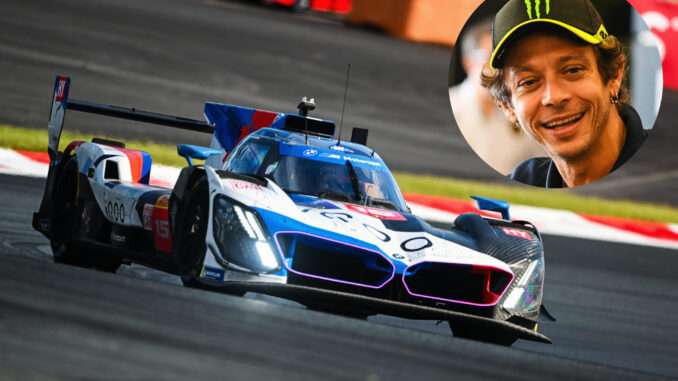
In a dramatic turn of events at one of motorsport’s most iconic and demanding circuits, Spa-Francorchamps, legendary MotoGP champion Valentino Rossi has raised serious concerns about the handling of the BMW GT3 cars. The issue? Persistent and frustrating understeer that is compromising lap times and threatening competitiveness in the third round of the FIA World Endurance Championship (WEC).
This revelation comes as a surprise to many fans and analysts alike, especially given the pedigree of both Rossi and BMW’s GT3 racing program. Rossi, now deep into his transition from two wheels to four, has been steadily developing his skills in endurance racing. Yet even with his growing experience and technical acumen, the Italian star finds himself fighting the car more than the competition.
A Legendary Voice Raises the Alarm
Rossi’s comments came during an interview with Motorsport Week, where he openly described the understeer issues plaguing the BMW M4 GT3 around Spa’s high-speed, flowing corners. “It’s in the long corners, especially places like Pouhon and Blanchimont,” Rossi explained, “where we are struggling. The front just doesn’t want to bite. We’re losing valuable tenths—and at this level, that’s the difference between the front and the midfield.”
Such transparency from a high-profile figure reflects not only his racing insight but also the seriousness of the problem. Understeer, a condition where the front wheels do not turn as sharply as intended, causing the car to push wide through corners, is a known Achilles’ heel for many GT cars. But when a driver of Rossi’s caliber sounds the alarm, the paddock listens.
The BMW M4 GT3: A Capable Machine, Tested to Its Limits
BMW’s M4 GT3 platform, launched with high expectations in the world of GT racing, has proven to be a competitive and well-engineered car in multiple championships. Featuring a 3.0-liter inline-six engine with twin turbochargers, the car combines cutting-edge aerodynamics with the German marque’s hallmark precision.
Yet Spa-Francorchamps, with its complex elevation changes and extended high-speed corners, poses a unique challenge. It demands a car that can maintain grip and balance through both technical sectors and full-throttle sections. It’s in these sweeping corners that the M4 GT3 seems to falter—understeering wide, forcing drivers to fight the car mid-corner, and compromising both exit speed and tire wear.
Sources within the BMW Team WRT garage have confirmed that setup changes have been made in an attempt to mitigate the problem. “We’ve been playing with the front-end geometry, dampers, and aero balance,” said one engineer, “but it’s a delicate balance. Too much front grip and we destabilize the rear, which is also not ideal at Spa.”
Teammates and Engineers Echo Concerns
Rossi isn’t alone in his frustrations. Fellow drivers within the BMW GT3 program have echoed his sentiments, albeit with a more technical tone. Maxime Martin, a Spa native and teammate of Rossi in several endurance events, described the handling quirks as “something we have to work around more than fix entirely.”
“The car is fundamentally strong,” Martin added, “but in these specific corner profiles—long, loaded, medium-to-high-speed turns—we don’t have the rotation we need. Drivers are compensating through driving style, but it’s not a long-term solution.”
BMW engineers are reportedly working closely with tire supplier Michelin to understand whether the understeer might also be linked to tire characteristics under Spa’s typically variable weather and surface temperatures.
Strategy Shifts and Real-Time Adjustments
With the understeer issue proving persistent, BMW teams have been forced to rethink their race strategies. Rossi hinted at changes in approach: “We’re having to manage tires more carefully and adjust our driving lines. It’s not the most natural way to drive the car, especially for me, coming from a motorcycle background where agility and precision are everything.”
Some teams are experimenting with alternate pit strategies to keep drivers in clear air and avoid traffic in key sectors where understeer is most costly. The goal: minimize the compounding effect of compromised handling in close-quarter racing.
In addition, engineers have been making real-time changes to anti-roll bars, camber settings, and even tweaking power delivery maps to subtly shift weight distribution during throttle application—all in pursuit of more front-end grip.
Spa-Francorchamps: A Temple of Speed and Precision
The Spa-Francorchamps circuit, nestled in the Ardennes forest, is revered by drivers for its sweeping layout and legendary corners. With corners like Eau Rouge, Raidillon, and Pouhon testing every aspect of a car’s dynamics, it is not uncommon for even top-tier machinery to struggle.
What makes Spa particularly punishing for a car prone to understeer is the length and load duration of its corners. Unlike stop-and-go tracks, Spa demands consistent front-end responsiveness over extended arcs. If the front tires begin to scrub or fade, lap time suffers immediately and dramatically.
Weather also plays a key role. Spa’s microclimate can change within a single lap, meaning that a car with handling issues in the dry could face exponentially worse problems when the track is damp or partially wet.
A True Test of Rossi’s Adaptation
For Rossi, this understeer dilemma is more than just a technical problem—it’s also a test of his adaptability as a driver. Having dominated MotoGP with instinctive balance and throttle control, his switch to GT racing has been watched closely by fans and pundits alike.
“I’m still learning a lot,” Rossi admitted. “The way you manage weight, rotation, and car balance is completely different. But that’s why I’m here—to push myself and learn something new. It’s frustrating when the car isn’t perfect, but this is racing. We adapt.”
Rossi’s evolution as a racer has already seen him achieve podiums in GT World Challenge events, and his dedication to the sport is evident. Despite the current handling woes, he remains optimistic about the team’s potential.
BMW’s Road Ahead
As the Spa round unfolds, BMW’s GT3 teams will be pressured to find solutions, not just to salvage results, but to prepare for future rounds where similar characteristics may appear, such as Monza or Fuji. The World Endurance Championship is as much about engineering development as race-day execution.
With Le Mans looming just weeks away, the insights gained from Spa could prove pivotal. If BMW can identify and resolve the causes of its understeer at Spa, it may pave the way for stronger showings on other long-corner, high-speed circuits.
Struggles Now, Hope Ahead
In motorsport, it’s often the response to adversity that defines a team’s character. Valentino Rossi and the BMW GT3 squad now face one such moment. Understeer may be slowing them down at Spa, but it has also illuminated areas for improvement, collaboration, and growth.
As one of racing’s most storied names, Rossi’s honest reflections bring both credibility and urgency to the issue. Whether this weekend results in a podium or not, the work being done behind the scenes is laying the groundwork for a better, faster, and more balanced BMW.
And knowing Rossi’s tenacity, it’s safe to say he won’t be backing off the throttle anytime soon.
Leave a Reply