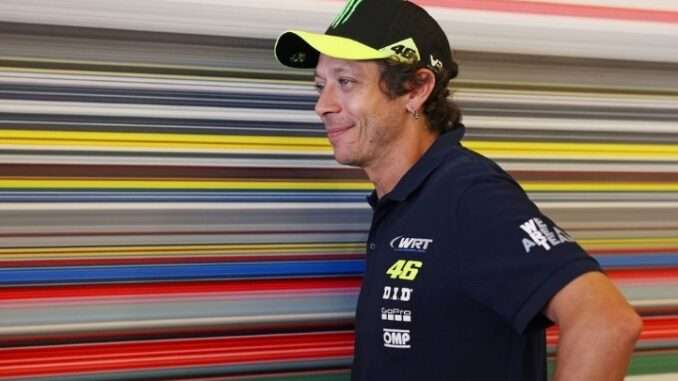
Valentino Rossi — nine-time world champion, MotoGP legend, mentor, academy founder, and latter-day four-wheeler — is shifting gears once again in 2025. After stepping away from MotoGP as a rider at the end of 2021, and spending recent years in car racing endeavours, Rossi has announced a deliberate recalibration of his focus. The intention: to be far more present in the motorcycle racing world, especially in MotoGP, as a mentor, team owner, and guiding influence for the next generation from his VR46 Academy. Below is the latest on what’s changed for Rossi in 2025 — his motivations, the stakes, and what this means for him, VR46, and the wider MotoGP landscape.
From Racer to Mentor: Rossi’s Evolving Role
When Rossi called time on his MotoGP riding career in 2021, many assumed that his shift toward car racing would become his main sporting identity. After all, through endurance racing (e.g. the World Endurance Championship, and events such as the 24 Hours of Le Mans) and GT racing he sought new challenges. But by late 2024, Rossi started expressing some regrets — specifically, over feeling distanced from the MotoGP paddock, and having missed out working closely with his Academy riders.
In response, Rossi has decided to scale back his car-racing commitments for 2025. He will still race in events like WEC and others, but less so than before, in order to free up time to attend more MotoGP rounds, to be seen more frequently in the paddock, and to engage with riders, engineers, and team management in a more hands-on way.
What “More Present in MotoGP” Means
Rossi himself has admitted that one of his regrets of 2024 was not attending enough MotoGP races and not being sufficiently involved with his Academy riders. He said that in 2025 he wants to be “more present at the MotoGP races… and do fewer car races for that reason.”
His team (VR46) has confirmed that he plans to attend at least six to seven rounds of the MotoGP calendar in 2025. Attendance won’t be symbolic; when he shows up, he will be in the pits, working with riders, mentor roles, giving input to the team — not simply as a figurehead.
The Factory-Backed Chapter of VR46
One of the most pivotal developments in 2025 is the VR46 Racing Team gaining full factory support from Ducati. Under a multi-year agreement, VR46 will field an official Desmosedici GP bike and enjoy the technical and sporting support of Ducati Corse.
This is a big upgrade. Previously, VR46 operated with satellite status (or associated with Ducati, but without “factory-backed” status). The move signals both greater responsibility and greater opportunity. It gives VR46 access to more up-to-date machinery and more direct involvement in the development chain. For riders, this means improved equipment and potentially more competitive results.
The line-up in VR46 for 2025 includes Franco Morbidelli (a former Academy rider and one of the earliest signees in VR46’s own team) and Fabio Di Giannantonio. Di Giannantonio, in particular, has the coveted GP25 spec Ducati — the factory’s latest machine — whilst Morbidelli will ride a slightly older spec (GP24).
So Rossi’s scaling back of four-wheeled commitments is timed to coincide with this enhanced factory support — meaning that his presence and input may have more impact, given that the team is in a stronger technical position.
Why the Change? Motivations Behind the Shift
Several intertwining motivations appear to underpin Rossi’s return to the paddock spotlight:
- Regret & Involvement: Rossi has publicly said he regretted being relatively absent in 2024 from MotoGP, especially as Academy mentor. He’s expressed a desire to work more closely with his riders.
- Generational Responsibility: The VR46 Riders Academy has produced big names (Francesco Bagnaia, Marco Bezzecchi, Franco Morbidelli, Luca Marini) and continues to recruit new talent. Rossi’s presence helps maintain visibility, discipline, mentorship, and the learned culture that made his own career special.
- Structural Changes in MotoGP: With shifts in ownership/management (Liberty Media’s involvement), changing dynamics in the paddock, and technical changes, Rossi seems keen to ensure that his VR46 operation remains competitive, influential, and well-positioned. Being more “inside” the paddock gives him more leverage, voice, and input.
- Team Loyalty & Legacy: VR46 is Rossi’s creation. Its performance (on the track and off) reflects on him. Strengthening the team, being present, ensuring that riders have his guidance are also legacy concerns. As team owner, mentor, and founder, he has personal stakes.
- Balancing Life & Racing: Reducing his car racing load allows for better focus—less travel, fewer conflicting schedule demands—so he can concentrate on what he feels matters more now: MotoGP, mentoring, team building, rather than personal racing glory in cars.
What This Means for Rossi, VR46, and MotoGP
- Boost in VR46 Team Performance Potential: With factory support from Ducati, better machines (GP25 for Di Giannantonio, GP24 for Morbidelli), and Rossi’s increased presence, the VR46 team is more likely to challenge for higher places — more podiums, perhaps even wins.
- Stronger Academy Pipeline: Rossi being more hands-on should benefit Academy riders (Morbidelli, Marini, others) in terms of coaching, race craft, mental preparation, technical development. Also, recruitment (as with the recent signing of Lorenzo Pritelli) shows Academy is active and growing.
- Greater Influence in Paddock Dynamics: As MotoGP changes (ownership, rules, competition), having legends like Rossi more involved could impact how teams interface with new policies, media, fan expectations. His presence draws public attention, sponsors, fan engagement.
- Reduced Car Racing, But Not Disappearance: Rossi isn’t quitting cars entirely — WEC and other commitments continue, but he expects to do fewer of them, to free up time. So he’ll still be active in four-wheeled motorsport, but less dominant in that space.
- Increased Pressure: With more visibility comes more scrutiny. As team owner and mentor, Rossi will be judged more heavily on VR46’s results; riders will be more aware of his oversight. Also, as competitors adapt, expectations rise.
Outstanding Questions & Watch-Points
- Exactly which MotoGP rounds Rossi will attend in 2025 — while six to seven is the target, which circuits, what timing, and how that presence will be structured (full race weekends, strategic meetings, etc.).
- How well VR46 can translate improved technical support and increased mentoring into results; will they close the gap to top factory teams?
- How Rossi balances reduced car-racing without losing momentum, personal satisfaction, or sponsorships tied to those disciplines.
- How MotoGP’s evolving structure — new rules, regulations, manufacturer changes, and ownership shifts — will affect Rossi’s strategic calculus, especially in terms of long-term influence of VR46.
- Whether Rossi’s presence will also extend to influencing regulatory, media, or commercial side of MotoGP (e.g. rider welfare, calendar structure, storytelling) more than before.
Looking Back & Looking Ahead
Rossi’s career is already etched in glory: from his earliest days in 125cc and 250cc, to dominating MotoGP, multiple team changes, massive fan base, and the mentor role. Moving into four-wheel racing was part passion, part extension of competition, but as time moves on, there’s a clear pull back to what made him who he is: motorcycles, young riders, the race weekend, the paddock.
2025 thus looks like a bridge year: for Rossi personally, between being a thrill-seeker racing cars and being a stodgy observer; for VR46, between satellite status and full factory support; for Academy riders, between being hopeful talents and fully supported challengers; and for MotoGP, between its past (with one of its greatest icons more in the saddle) and its future (with new faces but also respect for roots).
Conclusion
Valentino Rossi’s decision in 2025 is no retreat — instead it’s a re-centering. He’s scaling back secondary commitments in order to double down where it truly matters to him: in the paddock, with his team, and among the rising stars of two-wheel racing. His VR46 Racing Team is stronger than ever with factory Ducati backing; his Academy continues to recruit and nurture; and his presence will be increasingly felt in MotoGP.
For fans, this is welcome: Rossi—not just as nostalgia, but as active contributor. For riders under him, it’s guidance and leadership. For MotoGP, a chance to reaffirm tradition while pushing forward.
Leave a Reply