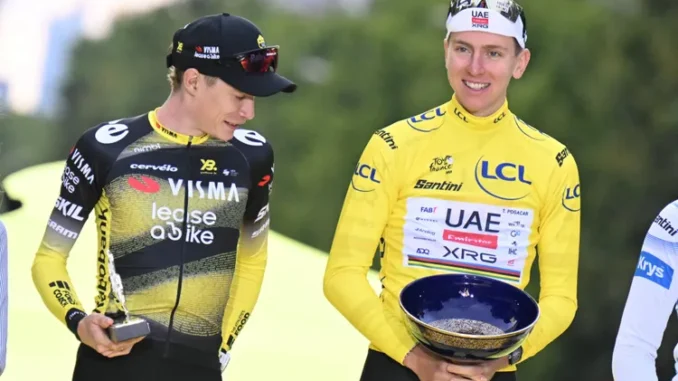
Inside Team Visma | Lease a Bike, Jonas Vingegaard’s planned Giro d’Italia ride in 2026 is not being framed as a detour from the Tour de France. It is being positioned as the most credible way to reset a rivalry with Tadej Pogacar that has stalled over the past two summers.
The Tour de France remains the team’s immovable priority. That has not changed. What has changed is Visma’s willingness to accept a difficult truth: their existing preparation model—while consistently competitive—has no longer been enough to beat Pogacar at his absolute peak.
Rather than defend a system that delivered podiums without yellow jerseys, Visma are choosing to introduce risk.
“We Were Well on the Way to Cracking Pogacar”
That mindset explains sports director Grischa Niermann’s striking assessment of last July’s Tour, quoted by IDL Pro Cycling.
“Last year his interviews afterwards showed we were well on the way to cracking Tadej,” Niermann said, pointing to Pogacar’s visible fatigue during the race.
The comment is not a declaration of moral victory. Nor is it a claim that Visma already held the upper hand. Instead, it reveals why the team believes standing still would be the greater failure. They saw enough vulnerability to justify changing course—not lowering expectations.
Externally, the idea of Vingegaard attempting a Giro–Tour double is being cast as a gamble that could compromise Visma’s July ambitions. Internally, the hierarchy remains brutally clear.
“We keep aiming to win the Tour, the biggest race in the world,” Niermann said. “Beating Tadej in the Tour is the highest thing we can achieve.”
The Giro as a Weapon, Not a Distraction
Within Visma, the Giro is being treated as a tool, not an alternative goal. Niermann was explicit that the Italian Grand Tour is not intended to be Vingegaard’s peak.
“We also definitely believe he can be better in the Tour than in the Giro,” he said.
That confidence is rooted less in theory than in Vingegaard’s own racing history. Visma repeatedly points to his successful Tour–Vuelta combinations, where sustained Grand Tour racing sharpened his form rather than blunted it.
“There’s no guarantee,” Niermann admitted. “But we do have the data from his Tour–Vuelta combinations, and that makes us believe.”
The emphasis on data is deliberate. This is not an emotional reaction to losing to Pogacar, nor a copycat attempt to mirror his rival’s race schedule. It is Visma applying the same evidence-driven logic that underpinned Vingegaard’s rise to the top of the sport.
Accepting Risk Because Repeating the Past Isn’t Enough
What Visma are now openly acknowledging is that repeating the same approach would likely produce the same result.
“We were doing well, but ultimately not good enough,” Niermann said. “Now there’s a different route again, and we have to approach it differently.”
That admission is revealing. Visma are not treating 2026 as a season of consolidation or damage control. The Giro–Tour double exists precisely because they still believe the Tour can be won—not because they have accepted Pogacar’s dominance as inevitable.
Niermann stopped short of explaining exactly how Visma plan to turn belief into advantage.
“We already have an idea, but we still have to fine-tune it,” he said.
The lack of detail is telling. Visma are not selling certainty. They are selling intent.
The gamble is real. So is the logic behind it. And from Visma’s perspective, the greatest risk would have been pretending the last two Tours didn’t demand a fundamentally different answer.
Leave a Reply