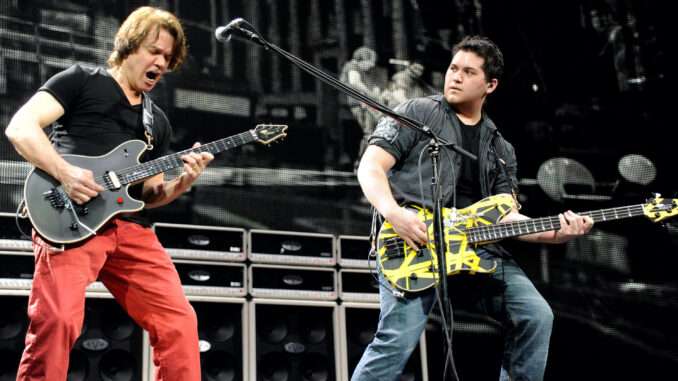
In the modern era of rock music, lineage often invites both admiration and scrutiny. For Wolfgang Van Halen, son of the late guitar icon Eddie Van Halen, the path to establishing his own identity has been uniquely challenging and deeply personal. Amid ongoing speculation and persistent assumptions that his father taught him how to play the guitar, Wolfgang recently made a clear and candid statement: Eddie did not teach him. This revelation came not from a place of defiance but from a deep respect for the independence he’s always pursued in his artistic journey.
The statement adds a compelling layer to the evolving narrative of Wolfgang’s career, especially as he continues to record and perform with his band, Mammoth WVH. His journey has been marked by talent, determination, and the weight of a legendary surname. And yet, as Wolfgang continues to rise in the music world, he does so under his banner, with his voice—and notably, on his terms.
The Legacy of a Titan: Eddie Van Halen
To appreciate the gravity of Wolfgang’s recent remarks, one must understand the magnitude of Eddie Van Halen’s influence. Widely regarded as one of the most innovative and electrifying guitarists in rock history, Eddie’s style—characterized by lightning-fast finger tapping, expressive harmonics, and a ferocious blend of classical and hard rock elements—transformed the landscape of guitar playing. His band, Van Halen, was one of the most commercially successful and culturally impactful acts of the late 20th century.
Fans naturally assumed that Eddie, whose musical genius was unparalleled, would pass down his knowledge to his son, especially when Wolfgang began playing bass for Van Halen in 2006 at just 15 years old. But as Wolfgang has made clear, his path was more self-determined.
“I Did It My Way”: Wolfgang’s Stand
In interviews and on social media, Wolfgang Van Halen has repeatedly emphasized that he taught himself how to play guitar. “Pop didn’t sit down and show me chords or solos,” he stated. “He was always there, but he never pushed or instructed.” The sentiment is striking not only because of what it implies about his independence but also because of what it says about Eddie Van Halen as a father.
While some might interpret the lack of formal instruction as a missed opportunity, Wolfgang views it as an empowering gesture. “He gave me the freedom to find my sound,” he explained. “He wanted me to be me.”
This autonomy in learning the instrument allowed Wolfgang to develop a distinct style—one that combines melody, precision, and emotional depth, distinct from the pyrotechnics his father was known for. Though he plays with intensity and technical skill, Wolfgang’s focus often leans more toward composition and lyrical storytelling.
Mammoth WVH and “The End”
Wolfgang’s band, Mammoth WVH, has been his main creative outlet since launching it in 2021. Unlike many musicians who rely on collaboration, Wolfgang writes, records, and performs nearly every instrument and vocal part on his albums. His sophomore release, expected later this year, continues this trend, solidifying him as a true one-man band.
One of the standout moments in the lead-up to the album’s release has been the unveiling of the song “The End.” In a behind-the-scenes video shared on Instagram, Wolfgang walks fans through his process in the studio. At one point, he reveals a powerful detail: he used Eddie’s iconic “Frankenstein” guitar for parts of the track.
“That guitar has a soul,” he said. “Using it makes me feel closer to Pop. It’s like he’s there with me in the studio.” The gesture is deeply symbolic. Though Eddie may not have been his instructor, his presence—both emotional and musical—remains an indelible part of Wolfgang’s journey.
The Shadow and the Spotlight
Wolfgang Van Halen has never shied away from acknowledging the complexities of growing up with a famous father. He has often described the duality of being immensely proud of his dad’s achievements while also feeling the pressure of being constantly compared to them.
His tenure with Van Halen—especially during the band’s 2007–2015 tours—placed him in the unforgiving spotlight of legacy rock fandom. Many were sceptical, questioning whether a teenager could fill the shoes of original bassist Michael Anthony. But Wolfgang held his ground, delivering performances marked by professionalism and skill. Over time, he won over many skeptics—not by trying to replicate the past, but by presenting himself authentically.
“People expect me to be a clone of my dad,” he said in an earlier interview. “But the truth is, I can’t be—and I don’t want to be. I want to respect what he built but also make something new.”
A Message to the Critics
Wolfgang’s rejection of the idea that Eddie taught him guitar is also, in some ways, a statement to critics and internet commentators who attempt to discredit his achievements by attributing them solely to nepotism. By asserting his independence, Wolfgang reinforces what his music has been saying all along: he is a self-made musician, not just an heir to a rock legacy.
That said, Wolfgang’s respect for his father is palpable. He speaks of Eddie with love, gratitude, and an unshakeable sense of reverence. But his mission is different: not to walk in his father’s footsteps, but to carve out a trail of his own.
Carrying the Flame, Not the Shadow
There’s something poetic about Wolfgang using the Frankenstein guitar in his recordings. It symbolizes both continuity and evolution. That guitar, with its striped paint job and patchwork design, was a Frankensteinian creation—crafted, tweaked, and perfected by Eddie himself. It was an extension of his soul. Now, in Wolfgang’s hands, it takes on new life, voicing new stories and carrying a new energy.
As Wolfgang continues to make his mark on rock music, his refusal to conform to public expectations has become part of his artistic identity. His journey is about honoring a legacy without being imprisoned by it.
Looking Ahead
With a new album on the horizon and momentum behind him, Wolfgang Van Halen’s musical evolution is far from over. He’s already proven that he has the talent, the work ethic, and the vision to stand on his own. And now, with the world finally seeing him for who he is—a multifaceted artist with his voice—the possibilities are endless.
The music world may forever associate him with Eddie Van Halen, and that’s understandable. But what Wolfgang is asking—through his interviews, his songwriting, and his statements—is simple: judge him not as a son, but as an artist in his own right.
And with every new song, every solo crafted on his terms, and every note played from his soul, Wolfgang Van Halen is doing exactly that—becoming a legend in his key.
Leave a Reply