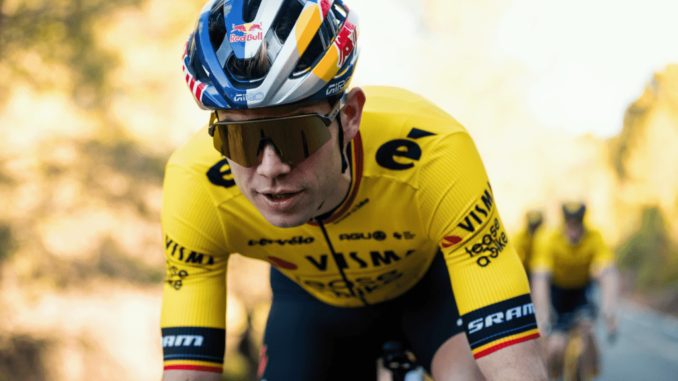
In a sport steeped in history, where legends are usually measured in monuments, victories and eras rather than marble or bronze, Wout van Aert has achieved something truly rare. The Belgian superstar has been immortalised in gold with the unveiling of a statue honouring his extraordinary contribution to modern cycling—an accolade that places him firmly among the pantheon of the sport’s greats while he is still very much active.
The golden statue, revealed in an emotional ceremony attended by fans, former champions, teammates and dignitaries, stands as a symbol not just of Van Aert’s palmarès, but of the way he has reshaped expectations of what a professional cyclist can be in the 21st century. Powerful yet versatile, dominant yet selfless, Van Aert’s career has transcended traditional categories and redefined the image of the modern cycling legend.
A Tribute Beyond Victories
Statues in cycling are rare and often reserved for riders whose careers have long since passed into history. Eddy Merckx, Rik Van Looy and Fausto Coppi are names commonly associated with such honours. That Wout van Aert now joins this exclusive company speaks volumes about the impact he has had—not only on Belgian cycling, but on the global sport.
The choice of gold as the statue’s finish is deliberate and symbolic. It represents excellence, durability and value beyond trends or eras. While Van Aert’s career has been filled with victories, yellow jerseys and unforgettable performances, the statue is not simply a tally of wins. It is a recognition of influence: the way he has inspired fans, teammates and rivals alike, and the way he has elevated every race he has entered.
The Rise of a Cyclocross Prodigy
Van Aert’s journey to this moment began far from the grandeur of WorldTour podiums. Like many Belgian champions, his foundations were laid in cyclocross. From an early age, he displayed a rare combination of technical skill, explosive power and mental resilience. His rivalry with Mathieu van der Poel in the muddy fields of winter racing quickly became one of the defining sporting duels of a generation.
Multiple world titles in cyclocross announced Van Aert as a once-in-a-generation talent, but they also hinted at something more. His performances suggested that his abilities would not be confined to one discipline. When he transitioned to the road full-time, expectations were high—but few could have predicted just how complete a rider he would become.
Redefining Versatility on the Road
In an era of extreme specialisation, Van Aert has stood out as a rider who defies categorisation. He wins bunch sprints against pure sprinters, survives and dominates mountain stages alongside GC contenders, time trials at the highest level, and remains one of the most feared riders on the cobbles.
This versatility has been a defining feature of his legend. Van Aert has won stages in all three Grand Tours, claimed green jerseys, conquered classics, and played decisive roles in some of the most dramatic moments of recent cycling history. His ability to adapt his racing style—sometimes aggressive, sometimes patient, sometimes entirely self-sacrificial—has made him indispensable to his teams and endlessly fascinating to watch.
The Ultimate Team Rider
What sets Van Aert apart from many other champions honoured with statues is not just how often he wins, but how often he gives up winning for others. In a sport where individual glory often takes precedence, Van Aert has repeatedly subordinated his own ambitions for the benefit of his team.
His performances in support of team leaders during Grand Tours have become legendary. Long mountain pulls, tactical sacrifices, and moments of sheer physical dominance have turned him into a symbol of modern teamwork. Fans remember not just his victories, but the days he rode himself to exhaustion so that a teammate could succeed.
That selflessness has earned him deep respect within the peloton and among cycling purists. The golden statue captures this dual identity: Van Aert the superstar, and Van Aert the servant of the collective.
A Belgian Icon for a New Generation
Belgium is a nation where cycling heroes are woven into cultural identity. From café walls to roadside monuments, the sport is everywhere. Van Aert’s statue is not just a personal honour; it is a reflection of his status as a national icon.
For a new generation of Belgian fans, Van Aert represents continuity with the past and hope for the future. He carries the weight of expectation that comes with Belgian cycling greatness, yet does so with humility and openness. His willingness to engage with fans, speak candidly about success and disappointment, and show vulnerability has made him relatable in a way that few superstars manage.
The statue has quickly become a gathering point for supporters, symbolising pride, resilience and modern Belgian cycling identity.
Rivalries That Defined an Era
No legend is complete without great rivals, and Van Aert’s career has been shaped by some of the most compelling rivalries in the sport’s recent history. His ongoing battles with Mathieu van der Poel have transcended disciplines, surfaces and seasons, captivating audiences worldwide.
Rather than diminishing his legacy, these rivalries have enhanced it. Each confrontation has pushed Van Aert to evolve, adapt and refine his racing. The mutual respect between rivals has elevated the sport itself, offering fans narratives that go beyond simple win-or-lose outcomes.
The statue stands as a reminder that greatness is often forged through competition, not isolation.
More Than an Athlete
The decision to honour Van Aert with a golden statue also reflects his influence beyond racing results. He has become a reference point for professionalism, preparation and consistency in modern cycling. Younger riders study his training methods, his race intelligence and his mental approach.
Off the bike, Van Aert has been a steady presence in a sport that has often struggled with turbulence. He represents stability in an era of rapid change, technological advancement and shifting expectations. Sponsors, teams and organisers alike see him as a figure who embodies the sport’s best values.
A Living Legacy
Perhaps the most remarkable aspect of the statue is that Van Aert’s story is not finished. Unlike many monuments that commemorate completed careers, this tribute honours a rider still writing new chapters. Every race he contests from now on adds layers of meaning to the statue that already stands in gold.
There is something uniquely powerful about celebrating greatness in the present tense. It allows fans to reflect not only on what has been achieved, but on what is still possible. Van Aert continues to line up at races with the same determination and hunger that defined his early years, even as history has already claimed him as one of its own.
Immortalised, Yet Human
Standing before the golden statue, observers are struck by a paradox. The figure represents immortality, yet the man it honours has always embraced the human side of sport—its doubts, sacrifices and imperfections. That balance is central to Van Aert’s appeal and to the decision to immortalise him in this way.
The statue does not signal the end of an era, but rather the recognition of one already unfolding. It acknowledges that cycling, like all great sports, occasionally produces athletes who transcend results and become symbols.
Wout van Aert, immortalised in gold, is now one of those symbols: a modern cycling legend whose legacy is already secure, even as the road ahead still beckons.
Leave a Reply